5-Amino-1MQ
5-Amino-1MQ (5-Amino-1-Methylquinolinium)
Research Hub — Aggregated Studies
MedTech Research Group aggregates published research from peer-reviewed journals, clinical trials, and academic institutions. We do not conduct original research. All studies cited below are the work of their respective authors and institutions. Sources are linked for verification.
This product is designated FOR RESEARCH USE ONLY (RUO). These compounds have not been approved or cleared under 21 U.S.C. § 505 and have not been evaluated by the FDA for safety, efficacy, or labeling for clinical, diagnostic, or therapeutic use in humans or animals.
MedTech Research Group will only fulfill orders to qualified researchers affiliated with accredited academic institutions, licensed research facilities, or organizations with active IRB/IACUC oversight.
Purchaser Restrictions
- Purchaser must be a qualified researcher at an accredited institution or licensed research facility
- This product may not be sold or redistributed to individual consumers, wellness clinics, health food stores, or retail establishments
- Not intended for human or animal consumption, diagnostic use, or therapeutic application
- Institutional affiliation and research purpose will be verified prior to order fulfillment
Distribution is limited to qualified research use in compliance with applicable federal and state law. These products bear the "For Research Use Only" designation per FDA labeling requirements (minimum 10 pt. font). Ref: 21 U.S.C. § 505; FD&C Act § 201(p) (unapproved new drug definition).
| Risk Tier | YELLOW |
| Category | Weight / Metabolic |
| Subcategory | NNMT Inhibition / NAD+ Restoration |
| Pharmacological Class | Small Molecule (not a peptide) |
| Subclass | Nicotinamide N-Methyltransferase (NNMT) Inhibitor |
| Molecular Type | Small molecule compound (5-amino-1-methylquinolinium, a quinolinium salt) |
| Origin | Synthetic — developed as a research tool compound for NNMT inhibition studies |
| Regulatory Status | Research Use Only. Not FDA-approved. Published preclinical data. |
| Route of Administration | Oral (capsule), subcutaneous injection |
| Reconstitution | Powder form (oral capsule) or lyophilized (for injection); reconstitute with bacteriostatic water if injectable |
| Storage | Room temperature or refrigerate; protect from moisture |
Chemical Properties
| Molecular Formula | C6H12O6 |
| Molecular Weight | 180.16 g/mol |
| Exact Mass | 180.06338810 Da |
| InChI Key | LKDRXBCSQODPBY-VRPWFDPXSA-N |
| Synonyms |
|
| PubChem | View full record |
Source: NCBI PubChem — public domain data
Bioactivity Data
3 assay results from ChEMBL CHEMBL1191168
| Ki | 1.8k nM | Furin | Homo sapiens |
| Ki | 1.8k nM | Furin | Homo sapiens |
| Ki | 3.3k nM | Furin | Homo sapiens |
Data from EMBL-EBI ChEMBL. CC BY-SA 3.0.
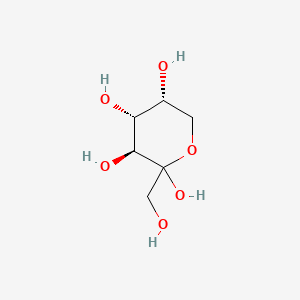
2D structure diagram from NCBI PubChem. This is the actual molecular structure of 5-Amino-1MQ.
Description
5-Amino-1MQ (5-amino-1-methylquinolinium) is a small molecule compound — not a peptide — that inhibits the enzyme nicotinamide N-methyltransferase (NNMT). Despite being listed in a peptide catalog, it is included because of its relevance to metabolic optimization and its synergistic potential with peptide-based protocols. NNMT is a cytosolic enzyme primarily expressed in adipose tissue, liver, and skeletal muscle that catalyzes the transfer of a methyl group from S-adenosylmethionine (SAM) to nicotinamide (a form of vitamin B3/niacin), producing 1-methylnicotinamide (1-MNA) and S-adenosylhomocysteine (SAH). This reaction has two important metabolic consequences: it depletes the NAD+ precursor pool (nicotinamide is a precursor for NAD+ synthesis via the salvage pathway) and it depletes SAM (the universal methyl donor required for DNA methylation, histone methylation, and numerous other methyltransferase reactions).
NNMT is significantly overexpressed in white adipose tissue of obese individuals and in visceral fat. This overexpression creates a metabolic "sink" that depletes both NAD+ and SAM in adipocytes, shifting their metabolic profile toward fat storage and away from fat oxidation. By inhibiting NNMT, 5-amino-1MQ reverses this metabolic reprogramming: it increases intracellular NAD+ levels (restoring mitochondrial oxidative metabolism), increases SAM availability (normalizing epigenetic regulation), reduces adipocyte lipid accumulation, and shifts white adipose tissue metabolism from lipogenic to lipolytic. In preclinical studies, NNMT inhibition by 5-amino-1MQ produced significant reductions in body fat without changes in food intake — suggesting the mechanism is metabolic rather than appetite-based.
Clinical Context
5-Amino-1MQ represents an emerging approach to metabolic disease that targets the fundamental biochemistry of fat cell energy metabolism rather than appetite, absorption, or hormonal signaling. The NNMT target is particularly compelling because it sits at the intersection of two critical metabolic pathways (NAD+ and methylation), both of which decline with age and obesity. The dual mechanism — restoring both NAD+ and SAM — distinguishes it from direct NAD+ supplementation (NR, NMN) which only addresses one pathway. The small molecule nature allows for oral administration, unlike most products in this catalog.
- NOT a peptide — it is a small molecule quinolinium salt; included in the catalog for metabolic relevance
- Oral bioavailability — can be administered as oral capsules, unlike most products in this catalog
- Mechanism is metabolic, not appetite-based — weight loss occurs through fat cell metabolic reprogramming without hunger reduction
- Preclinical data only — no human clinical trials completed
- Two sizes: 5mg capsule ($26.68) for research dosing and 50mg ($71.60) for larger-scale studies
- May complement NAD+ precursor supplementation (NR, NMN) by preserving the nicotinamide pool that NNMT would otherwise deplete
- The 1-methylnicotinamide (1-MNA) product of NNMT activity has its own biological effects — inhibiting NNMT will reduce 1-MNA levels, which may have implications (1-MNA has reported anti-inflammatory and vasoprotective properties)
Published Research
Published Research & Clinical Data
Peer-reviewed studies and clinical trial data related to 5-Amino-1MQ
20 from PubChem
All research below is conducted by independent institutions. MedTech Research Group provides these references for informational purposes only.
Diet-induced protection against lipopolysaccharide includes increased hepatic NO production.
Harris HW, Rockey DC, Young DM, Welch WJ. The Journal of surgical research, 1999.PMID: 10090849
Kishi K, Tanaka T, Igawa M, Takase S, Goda T. The Journal of nutrition, 1999.PMID: 10222385
Impaired vagal reflex activity in insulin-resistant rats.
Miller AW, Sims JJ, Canavan A, Hsu T, Ujhelyi MR. Journal of cardiovascular pharmacology, 1999.PMID: 10226855
Monteiro IM, Jiang L, Ferraris RP. Journal of pediatric gastroenterology and nutrition, 1999.PMID: 10554124
Shinozaki K, Kashiwagi A, Nishio Y, Okamura T, Yoshida Y, et al.. Diabetes, 1999.PMID: 10580434
Bosentan reduces blood pressure and the target-organ damage induced by a high-fructose diet in rats.
Cosenzi A, Bernobich E, Plazzotta N, Seculin P, Bellini G. Journal of hypertension, 1999.PMID: 10703878
Levy JR, Gyarmati J, Lesko JM, Adler RA, Stevens W. American journal of physiology. Endocrinology and metabolism, 2000.PMID: 10780946
Sterol regulatory element-binding protein-1 is regulated by glucose at the transcriptional level.
Hasty AH, Shimano H, Yahagi N, Amemiya-Kudo M, Perrey S, et al.. The Journal of biological chemistry, 2000.PMID: 10913129
Developmental reprogramming of rat GLUT-5 requires de novo mRNA and protein synthesis.
Jiang L, Ferraris RP. American journal of physiology. Gastrointestinal and liver physiology, 2001.PMID: 11123204
Lee DH, Lee JU, Kang DG, Paek YW, Chung DJ, et al.. Metabolism: clinical and experimental, 2001.PMID: 11172478
Regulation of the expression of carbohydrate digestion/absorption-related genes.
Goda T. The British journal of nutrition, 2000.PMID: 11242478
Rémillard P, Shen G, Milne R, Maheux P. Life sciences, 2001.PMID: 11476189
GLUT-5 expression in neonatal rats: crypt-villus location and age-dependent regulation.
Jiang L, David ES, Espina N, Ferraris RP. American journal of physiology. Gastrointestinal and liver physiology, 2001.PMID: 11518678
Intestinal perfusion induces rapid activation of immediate-early genes in weaning rats.
Jiang L, Lawsky H, Coloso RM, Dudley MA, Ferraris RP. American journal of physiology. Regulatory, integrative and comparative physiology, 2001.PMID: 11557636
Juan CC, Au LC, Fang VS, Kang SF, Ko YH, et al.. Biochemical and biophysical research communications, 2001.PMID: 11741341
High-fructose diet decreases catalase mRNA levels in rat tissues.
Cavarape A, Feletto F, Mercuri F, Quagliaro L, Daman G, et al.. Journal of endocrinological investigation, 2001.PMID: 11817707
Amelioration of high fructose-induced metabolic derangements by activation of PPARalpha.
Nagai Y, Nishio Y, Nakamura T, Maegawa H, Kikkawa R, et al.. American journal of physiology. Endocrinology and metabolism, 2002.PMID: 11934685
Ostos MA, Recalde D, Baroukh N, Callejo A, Rouis M, et al.. The Journal of nutrition, 2002.PMID: 11983814
Quinapril treatment restores the vasodilator action of insulin in fructose-hypertensive rats.
Uchida T, Okumura K, Ito T, Kamiya H, Nishimoto Y, et al.. Clinical and experimental pharmacology & physiology, 2002.PMID: 12010179
Cloning and functional characterization of the mouse fructose transporter, GLUT5.
Corpe CP, Bovelander FJ, Munoz CM, Hoekstra JH, Simpson IA, et al.. Biochimica et biophysica acta, 2002.PMID: 12031501
Research Library — 10 Papers
Research data sourced from OpenAlex. CC0 public domain. Articles are the work of their respective authors.
MedTech Research Group provides these references for informational purposes. We do not conduct original research. All studies are the work of their respective authors and institutions.
Nicotinamide N-Methyltransferase: A Promising Biomarker and Target for Human Cancer Therapy
Xiaoyu Li, Yanan Pi, Yao Chen, et al. · Frontiers in Oncology
Research by Xiaoyu Li et al., published in Frontiers in Oncology. Not conducted by MedTech Research Group.
Chromatin and Cancer: Implications of Disrupted Chromatin Organization in Tumorigenesis and Its Diversification
Poonam Sehgal, Pankaj Chaturvedi · Cancers
Research by Poonam Sehgal et al., published in Cancers. Not conducted by MedTech Research Group.
Nicotinamide N-methyltransferase (NNMT): a novel therapeutic target for metabolic syndrome
Wei-Dong Sun, Xiaojuan Zhu, Jingjing Li, et al. · Frontiers in Pharmacology
Research by Wei-Dong Sun et al., published in Frontiers in Pharmacology. Not conducted by MedTech Research Group.
Roles of Nicotinamide N‐Methyltransferase in Obesity and Type 2 Diabetes
Jie-Ru Liu, Zhaohui Deng, Xiaojuan Zhu, et al. · BioMed Research International
Research by Jie-Ru Liu et al., published in BioMed Research International. Not conducted by MedTech Research Group.
Nicotinamide N-methyltransferase inhibition mimics and boosts exercise-mediated improvements in muscle function in aged mice
Andrea Dimet‐Wiley, Christine M. Latham, Camille R. Brightwell, et al. · Scientific Reports
Research by Andrea Dimet‐Wiley et al., published in Scientific Reports. Not conducted by MedTech Research Group.
Biological Functions and Therapeutic Potential of NAD+ Metabolism in Gynecological Cancers
Subin Myong, Anh Nguyen, Sridevi Challa · Cancers
Research by Subin Myong et al., published in Cancers. Not conducted by MedTech Research Group.
Reduced calorie diet combined with NNMT inhibition establishes a distinct microbiome in DIO mice
Andrea Dimet‐Wiley, Qinglong Wu, Jerrin T. Wiley, et al. · Scientific Reports
Research by Andrea Dimet‐Wiley et al., published in Scientific Reports. Not conducted by MedTech Research Group.
Nicotinamide N-Methyltransferase in the Inflammatory Pathogenesis of Graves’ Orbitopathy
Dayoon Cho, Soo Hyun Choi, Jin Sook Yoon, et al. · Investigative Ophthalmology & Visual Science
Research by Dayoon Cho et al., published in Investigative Ophthalmology & Visual Science. Not conducted by MedTech Research Group.
Nicotinamide N-Methyltransferase (NNMT) and Liver Cancer: From Metabolic Networks to Therapeutic Targets
Shi-Yan Lai, Xiaojuan Zhu, Wei-Dong Sun, et al. · Biomolecules
Research by Shi-Yan Lai et al., published in Biomolecules. Not conducted by MedTech Research Group.
Development of fluorescence polarization-based competition assay for nicotinamide <i>N</i> -methyltransferase
Iredia D. Iyamu, Rong Huang · bioRxiv (Cold Spring Harbor Laboratory)
Research by Iredia D. Iyamu et al., published in bioRxiv (Cold Spring Harbor Laboratory). Not conducted by MedTech Research Group.