CJC-1295 Without DAC
Research Hub — Aggregated Studies
MedTech Research Group aggregates published research from peer-reviewed journals, clinical trials, and academic institutions. We do not conduct original research. All studies cited below are the work of their respective authors and institutions. Sources are linked for verification.
This product is designated FOR RESEARCH USE ONLY (RUO). These compounds have not been approved or cleared under 21 U.S.C. § 505 and have not been evaluated by the FDA for safety, efficacy, or labeling for clinical, diagnostic, or therapeutic use in humans or animals.
MedTech Research Group will only fulfill orders to qualified researchers affiliated with accredited academic institutions, licensed research facilities, or organizations with active IRB/IACUC oversight.
Purchaser Restrictions
- Purchaser must be a qualified researcher at an accredited institution or licensed research facility
- This product may not be sold or redistributed to individual consumers, wellness clinics, health food stores, or retail establishments
- Not intended for human or animal consumption, diagnostic use, or therapeutic application
- Institutional affiliation and research purpose will be verified prior to order fulfillment
Distribution is limited to qualified research use in compliance with applicable federal and state law. These products bear the "For Research Use Only" designation per FDA labeling requirements (minimum 10 pt. font). Ref: 21 U.S.C. § 505; FD&C Act § 201(p) (unapproved new drug definition).
| Risk Tier | YELLOW |
| Category | Growth Hormone Axis |
| Subcategory | GH Secretagogue (Modified GHRH Analog) |
| Pharmacological Class | Modified Peptide Hormone Analog |
| Subclass | Modified Growth Hormone-Releasing Hormone Analog |
| Molecular Type | Synthetic Modified Peptide (30 amino acids, 4 amino acid substitutions from native GHRH(1-29)) |
| Origin | Synthetic, engineered from GHRH with substitutions at positions 2, 8, 15, and 27 for DPP-IV resistance |
| Regulatory Status | Research Use Only. Not FDA-approved. Developed by ConjuChem Biotechnologies. |
| Route of Administration | Subcutaneous injection |
| Reconstitution | Lyophilized powder; reconstitute with bacteriostatic water |
| Storage | Refrigerate (2-8°C) |
Bioactivity Data
2 assay results from ChEMBL CHEMBL5927611
| IC50 | 13.00 nM | P2X purinoceptor 7 | Homo sapiens |
| IC50 | 13.00 nM | P2X purinoceptor 7 | Homo sapiens |
Data from EMBL-EBI ChEMBL. CC BY-SA 3.0.
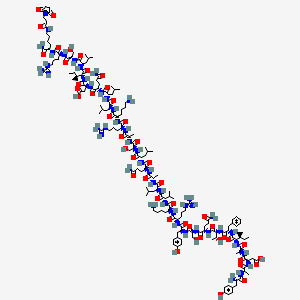
2D structure diagram from NCBI PubChem. This is the actual molecular structure of CJC-1295 Without DAC.
Description
CJC-1295 without DAC (also referred to as Modified GRF 1-29 or MOD-GRF 1-29) is a synthetic analog of the first 29 amino acids of growth hormone-releasing hormone (GHRH) that has been engineered with four specific amino acid substitutions designed to dramatically improve its resistance to enzymatic degradation. The substitutions are: Ala2 to D-Ala2 (protects against DPP-IV cleavage at the critical N-terminal position), Asn8 to Gln8 (prevents asparagine deamidation), Ala15 to Ala15 or Leu15 (improves bioactivity), and Met27 to Leu27 (prevents methionine oxidation). These modifications extend the half-life from the ~10 minutes of native GHRH to approximately 30 minutes for the "without DAC" version.
The mechanism of action is identical to native GHRH and sermorelin — binding to GHRH receptors on anterior pituitary somatotrophs and stimulating pulsatile growth hormone release via the cAMP/PKA signaling cascade. The key pharmacological advantage over sermorelin is the significantly improved metabolic stability provided by the amino acid substitutions, which translates to more reliable and robust GH pulses per injection. The "without DAC" version produces acute, high-amplitude GH pulses that more closely mimic the natural pulsatile pattern of GH secretion, with each pulse lasting approximately 2-3 hours. This is generally considered more physiological than the sustained elevation produced by the "with DAC" version.
Clinical Context
CJC-1295 without DAC is one of the most widely used GH secretagogues in research and clinical practice. Its improved stability over sermorelin and its preservation of pulsatile GH release patterns (compared to the sustained elevation of the DAC version) have made it a preferred choice for practitioners seeking to augment GH secretion while maintaining physiological release kinetics. It is frequently combined with ipamorelin (see CJC-1295/Ipamorelin Blend) for synergistic effects through dual-receptor activation.
- Requires a functional anterior pituitary gland
- The ~30-minute half-life means the GH pulse is acute and pulsatile — typical dosing is 2-3 times daily
- Evening/bedtime dosing is preferred to augment the natural nocturnal GH surge
- Administer on an empty stomach (fats and carbohydrates blunt GH release)
- More potent and reliable GH stimulation than sermorelin due to DPP-IV resistance
- The distinction between 'without DAC' and 'with DAC' is clinically important — they produce very different GH release kinetics
- Well-tolerated; most common adverse effects are injection site reactions, flushing, and transient dizziness
Published Research
Published Research & Clinical Data
Peer-reviewed studies and clinical trial data related to CJC-1295 Without DAC
All research below is conducted by independent institutions. MedTech Research Group provides these references for informational purposes only.
Research citations are being compiled for this compound.
Check back soon — our team is curating peer-reviewed sources.
17 Registered Clinical Trials
Research data sourced from ClinicalTrials.gov. Public domain (U.S. National Library of Medicine).
MedTech Research Group provides these references for informational purposes. We do not conduct original research. All studies are the work of their respective authors and institutions.
17
Total Trials
3
Recruiting
0
Active
9
Completed
Sponsor: ConjuChem · Completed: 2006-09
Sponsor: Theratechnologies · Completed: 2008-10
Sponsor: Theratechnologies · Completed: 2018-08
Sponsor: Hudson Biotech · Completed: 2028-02-17
Sponsor: Theratechnologies · Completed: 2008-07
Research Library — 51 Papers
Research data sourced from OpenAlex. CC0 public domain. Articles are the work of their respective authors.
MedTech Research Group provides these references for informational purposes. We do not conduct original research. All studies are the work of their respective authors and institutions.
Growth Hormone Doping in Sports: A Critical Review of Use and Detection Strategies
Gerhard Baumann · Endocrine Reviews
Research by Gerhard Baumann, published in Endocrine Reviews. Not conducted by MedTech Research Group.
Heterogeneity Among White Adipose Tissue Depots in Male C57BL/6J Mice
Lucila Sackmann‐Sala, Darlene E. Berryman, Rachel D. Munn, et al. · Obesity
Research by Lucila Sackmann‐Sala et al., published in Obesity. Not conducted by MedTech Research Group.
DNA damage and growth hormone hypersecretion in pituitary somatotroph adenomas
Anat Ben-Shlomo, Nan Deng, Evelyn Ding, et al. · Journal of Clinical Investigation
Research by Anat Ben-Shlomo et al., published in Journal of Clinical Investigation. Not conducted by MedTech Research Group.
Analysis of pharmaceutical products and dietary supplements seized from the black market among bodybuilders
Nicolas Fabresse, Laurie Gheddar, Pascal Kintz, et al. · Forensic Science International
Research by Nicolas Fabresse et al., published in Forensic Science International. Not conducted by MedTech Research Group.
Proteomics in Forensic Analysis: Applications for Human Samples
Van‐An Duong, Jong‐Moon Park, Hee–Joung Lim, et al. · Applied Sciences
Research by Van‐An Duong et al., published in Applied Sciences. Not conducted by MedTech Research Group.
Plasma biomarker proteins for detection of human growth hormone administration in athletes
Sock-Hwee Tan, Albert Lee, Dana Pascovici, et al. · Scientific Reports
Research by Sock-Hwee Tan et al., published in Scientific Reports. Not conducted by MedTech Research Group.
Plasma biomarkers of mouse aging
Juan Ding, John J. Kopchick · AGE
Research by Juan Ding et al., published in AGE. Not conducted by MedTech Research Group.
Netnography of Female Use of the Synthetic Growth Hormone CJC-1295: Pulses and Potions
Marie Claire Van Hout, Evelyn Hearne · Substance Use & Misuse
Research by Marie Claire Van Hout et al., published in Substance Use & Misuse. Not conducted by MedTech Research Group.
Qualitative identification of growth hormone-releasing hormones in human plasma by means of immunoaffinity purification and LC-HRMS/MS
André Knoop, Andreas Thomas, Eric Fichant, et al. · Analytical and Bioanalytical Chemistry
Research by André Knoop et al., published in Analytical and Bioanalytical Chemistry. Not conducted by MedTech Research Group.
Neuronal M<sub>3</sub>muscarinic acetylcholine receptors are essential for somatotroph proliferation and normal somatic growth
Dinesh Gautam, Jongrye Jeon, Matthew F. Starost, et al. · Proceedings of the National Academy of Sciences
Research by Dinesh Gautam et al., published in Proceedings of the National Academy of Sciences. Not conducted by MedTech Research Group.