Epitalon
Epitalon (Epithalon / Epithalone)
Research Hub — Aggregated Studies
MedTech Research Group aggregates published research from peer-reviewed journals, clinical trials, and academic institutions. We do not conduct original research. All studies cited below are the work of their respective authors and institutions. Sources are linked for verification.
This product is designated FOR RESEARCH USE ONLY (RUO). These compounds have not been approved or cleared under 21 U.S.C. § 505 and have not been evaluated by the FDA for safety, efficacy, or labeling for clinical, diagnostic, or therapeutic use in humans or animals.
MedTech Research Group will only fulfill orders to qualified researchers affiliated with accredited academic institutions, licensed research facilities, or organizations with active IRB/IACUC oversight.
Purchaser Restrictions
- Purchaser must be a qualified researcher at an accredited institution or licensed research facility
- This product may not be sold or redistributed to individual consumers, wellness clinics, health food stores, or retail establishments
- Not intended for human or animal consumption, diagnostic use, or therapeutic application
- Institutional affiliation and research purpose will be verified prior to order fulfillment
Distribution is limited to qualified research use in compliance with applicable federal and state law. These products bear the "For Research Use Only" designation per FDA labeling requirements (minimum 10 pt. font). Ref: 21 U.S.C. § 505; FD&C Act § 201(p) (unapproved new drug definition).
| Risk Tier | GREEN |
| Category | Longevity / Anti-Aging |
| Subcategory | Telomerase Activation, Pineal Gland Function |
| Pharmacological Class | Peptide Bioregulator |
| Subclass | Synthetic Tetrapeptide (Pineal Gland Bioregulator) |
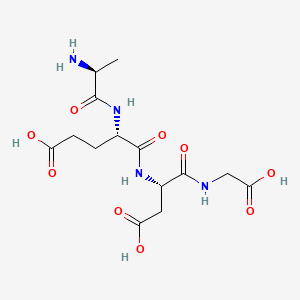
| Molecular Type | Synthetic Tetrapeptide (4 amino acids: Ala-Glu-Asp-Gly) |
| Origin | Synthetic — developed by Professor Vladimir Khavinson at the St. Petersburg Institute of Bioregulation and Gerontology (Russia) as a synthetic version of epithalamin, a peptide extract from the pineal gland |
| Regulatory Status | Research Use Only. Not FDA-approved. Approved in Russia as a peptide bioregulator (not as a pharmaceutical drug). |
| Route of Administration | Subcutaneous injection, intravenous injection |
| Reconstitution | Lyophilized powder; reconstitute with bacteriostatic water |
| Storage | Refrigerate (2-8°C) |
Chemical Properties
| Molecular Formula | C14H22N4O9 |
| Molecular Weight | 390.35 g/mol |
| Exact Mass | 390.13867829 Da |
| InChI Key | HGHOBRRUMWJWCU-FXQIFTODSA-N |
| Synonyms |
|
| PubChem | View full record |
Source: NCBI PubChem — public domain data
2D structure diagram from NCBI PubChem. This is the actual molecular structure of Epitalon.
Description
Epitalon (also spelled Epithalon or Epithalone) is a synthetic tetrapeptide (Ala-Glu-Asp-Gly) developed by Russian gerontologist Professor Vladimir Khavinson, who has spent over 40 years researching peptide bioregulators — short peptides that he theorizes can regulate gene expression in specific tissues by interacting with DNA and histone proteins. Epitalon is the synthetic version of epithalamin, a complex peptide extract derived from the pineal gland of young animals.
The primary mechanism of interest is Epitalon's demonstrated ability to activate telomerase — the enzyme that adds telomeric repeats (TTAGGG sequences) to the ends of chromosomes. Telomeres are the protective caps on chromosome ends that shorten with each cell division, acting as a biological clock that limits the number of times a cell can divide (the Hayflick limit). When telomeres reach a critically short length, cells enter senescence (permanent growth arrest) or undergo apoptosis. Telomere shortening is one of the hallmarks of cellular aging, and telomere length is correlated with biological age, disease risk, and mortality.
In cell culture studies, Epitalon has been shown to activate the gene for the catalytic subunit of telomerase (hTERT), increasing telomerase activity and enabling cells to exceed their normal replicative lifespan. In human fetal lung fibroblasts, Epitalon treatment increased telomere length by approximately 33% and extended the replicative lifespan of the cells beyond the Hayflick limit — a remarkable finding. In animal studies, Khavinson's group reported that epithalamin (the pineal extract) and Epitalon increased maximum lifespan in mice by 10-20% and decreased the incidence of spontaneous tumors.
Beyond telomerase activation, Epitalon has demonstrated effects on the pineal gland and melatonin production. With age, the pineal gland calcifies and melatonin production decreases. Epitalon has been shown to restore evening melatonin peaks in elderly primates and humans, normalize circadian rhythm, and improve sleep quality. Melatonin itself has significant antioxidant and immunomodulatory properties, so restoration of youthful melatonin production may contribute to broader anti-aging effects.
Clinical Context
Epitalon is unique in the peptide market for its telomerase-activating properties. While the research is primarily from Russian academic groups (which can create publication bias concerns for Western clinicians), the underlying science of telomere biology is well-established in mainstream gerontology. The telomerase activator TA-65 (derived from astragalus) has been commercially successful in the supplement market, validating consumer demand for telomere-targeting interventions.
The very low cost ($19.77 for 10mg, 80.2% margin) makes Epitalon one of the most cost-effective products in the catalog.
- Telomerase activation is a double-edged sword: while it can extend normal cell lifespan, cancer cells also utilize telomerase to achieve replicative immortality; however, animal studies have NOT shown increased cancer incidence with Epitalon — in fact, tumor incidence decreased
- Most published research comes from Russian academic institutions; Western replication studies are limited
- Typical research protocols use 10-day cycles (5-10mg/day) separated by 4-6 month intervals
- Well-tolerated in reported studies with no significant adverse effects
- The N-Acetyl Epitalon Amidate variant (YPB.232) is a modified form designed for enhanced stability and bioavailability
Published Research
Published Research & Clinical Data
Peer-reviewed studies and clinical trial data related to Epitalon
20 from PubChem
All research below is conducted by independent institutions. MedTech Research Group provides these references for informational purposes only.
[Effect of pineal peptide on parameters of the biological age and life span in mice].
Anisimov VN, Khavinson VKh, Zavarzina NIu, Zabezhinskiĭ MA, Zimina OA, et al.. Rossiiskii fiziologicheskii zhurnal imeni I.M. Sechenova, 2001.PMID: 11227856
Reparative effect of epithalon on pineal gland ultrastructure in gamma-irradiated rats.
Khavinson VK, Yakovleva ND, Popuchiev VV, Kvetnoi IM, Manokhina RP. Bulletin of experimental biology and medicine, 2001.PMID: 11329090
Khavinson VK, Yuzhakov VV, Kvetnoi IM, Malinin VV, Popuchiev VV, et al.. Bulletin of experimental biology and medicine, 2001.PMID: 11427924
[Effect of pineal peptides on neuroendocrine system after pinealectomy].
Khavinson VKh, Kvetnoĭ IM, Popuchiev VV, Iuzhakov VV, Kotlova LN. Arkhiv patologii, 2001.PMID: 11452647
Synthetic tetrapeptide epitalon restores disturbed neuroendocrine regulation in senescent monkeys.
Khavinson V, Goncharova N, Lapin B. Neuro endocrinology letters, 2001.PMID: 11524632
Regulatory effect of Epithalon on production of melatonin and cortisol in old monkeys.
Goncharova ND, Khavinson BK, Lapin BA. Bulletin of experimental biology and medicine, 2001.PMID: 11550036
Khavinson VK, Myl'nikov SV, Oparina TI, Arutyunyan AV. Bulletin of experimental biology and medicine, 2001.PMID: 11687853
[Effect of epithalone on growth kinetics and functional morphology of M-1 sarcoma].
Khavinson VKh, Iuzhakov VV, Kvetnoĭ IM, Malinin VV. Voprosy onkologii, 2001.PMID: 11710291
[Effect of vilon and epithalone on induction and growth of induced bladder neoplasms in rats].
Pliss GB, Mel'nikov AS, Malinin VV, Khavinson VKh. Voprosy onkologii, 2001.PMID: 11785104
Khavinson VK, Konovalov SS, Yuzhakov VV, Popuchiev VV, Kvetnoi IM. Bulletin of experimental biology and medicine, 2001.PMID: 11865335
Anisimov VN, Khavinson VKh, Popovich IG, Zabezhinski MA. Cancer letters, 2002.PMID: 12049808
Khavinson VKh, Golubev AG. Advances in gerontology = Uspekhi gerontologii, 2002.PMID: 12096440
[Effect of Epitalon and Vilon treatment on mammary carcinogenesis in transgenic erbB-2/NEU mice].
Alimova IN, Bashurin DA, Popovich IG, Zabezhinskiĭ MA, Volkov MA, et al.. Voprosy onkologii, 2002.PMID: 12101568
Khavinson VKh, Razumovskii MI, Trofimova SV, Grigor'yan RA, Chaban TV, et al.. Bulletin of experimental biology and medicine, 2002.PMID: 12170316
Pineal-regulating tetrapeptide epitalon improves eye retina condition in retinitis pigmentosa.
Khavinson V, Razumovsky M, Trofimova S, Grigorian R, Razumovskaya A. Neuro endocrinology letters, 2002.PMID: 12195242
Anisimov VN, Khavinson VK, Provinciali M, Alimova IN, Baturin DA, et al.. International journal of cancer, 2002.PMID: 12209581
Effect of epithalon on the incidence of chromosome aberrations in senescence-accelerated mice.
Rosenfeld SV, Togo EF, Mikheev VS, Popovich IG, Khavinson VKh, et al.. Bulletin of experimental biology and medicine, 2002.PMID: 12360351
Effects of epithalon on activities gastrointestinal enzymes in young and old rats.
Khavinson VKh, Malinin VV, Timofeeva NM, Egorova VV, Nikitina AA. Bulletin of experimental biology and medicine, 2002.PMID: 12360355
Anisimov SV, Bokheler KR, Khavinson VKh, Anisimov VN. Bulletin of experimental biology and medicine, 2002.PMID: 12360356
Khavinson VKh. Neuro endocrinology letters, 2002.PMID: 12374906
Research Library — 9 Papers
Research data sourced from OpenAlex. CC0 public domain. Articles are the work of their respective authors.
MedTech Research Group provides these references for informational purposes. We do not conduct original research. All studies are the work of their respective authors and institutions.
Peptides: Prospects for Use in the Treatment of COVID-19
Vladimir Khavinson, N. S. Linkova, Anastasiia Dyatlova, et al. · Molecules
Research by Vladimir Khavinson et al., published in Molecules. Not conducted by MedTech Research Group.
Biomedicines in Longevity and Aging The Quest to Resist Biological Decline
Raymond D D Raymond · Biomedicine
Research by Raymond D D Raymond, published in Biomedicine. Not conducted by MedTech Research Group.
Overview of Epitalon—Highly Bioactive Pineal Tetrapeptide with Promising Properties
Szymon Kamil Araj, Jakub Brzezik, Katarzyna Mądra-Gackowska, et al. · International Journal of Molecular Sciences
Research by Szymon Kamil Araj et al., published in International Journal of Molecular Sciences. Not conducted by MedTech Research Group.
The Antioxidant Tetrapeptide Epitalon Enhances Delayed Wound Healing in an in Vitro Model of Diabetic Retinopathy
Marco Gatta, Melania Dovizio, Cristina Milillo, et al. · Stem Cell Reviews and Reports
Research by Marco Gatta et al., published in Stem Cell Reviews and Reports. Not conducted by MedTech Research Group.
Improving Biological Age, Telomere Length, and Cognition: A Case Report on the Use of Therapeutic Plasma Exchange, Peptides, Umbilical Cord Tissue Mesenchymal Stem Cells and Exosomes in a Patient with Cognitive Decline
Edwin Lee, Morgan Burns · Journal of Restorative Medicine
Research by Edwin Lee et al., published in Journal of Restorative Medicine. Not conducted by MedTech Research Group.
Epitalon increases telomere length in human cell lines through telomerase upregulation or ALT activity
Sarah Al-dulaimi, Ross S. Thomas, Sheila Matta, et al. · Biogerontology
Research by Sarah Al-dulaimi et al., published in Biogerontology. Not conducted by MedTech Research Group.
Epitalon increases telomere length in human cell lines through telomerase upregulation or ALT activity
Sarah Al-dulaimi, Ross S. Thomas, Sheila Matta, et al. · Research Square
Research by Sarah Al-dulaimi et al., published in Research Square. Not conducted by MedTech Research Group.
Exploring Peptides for Neurological Health & Longevity
Liz Sutherland
Research by Liz Sutherland. Not conducted by MedTech Research Group.
Therapeutic peptides in gerontology: mechanisms and applications for healthy aging
Volodymyr Mavrych, Inna Shypilova, Olena Bolgova · Frontiers in Aging
Research by Volodymyr Mavrych et al., published in Frontiers in Aging. Not conducted by MedTech Research Group.