FOXO4-DRI
Research Hub — Aggregated Studies
MedTech Research Group aggregates published research from peer-reviewed journals, clinical trials, and academic institutions. We do not conduct original research. All studies cited below are the work of their respective authors and institutions. Sources are linked for verification.
This product is designated FOR RESEARCH USE ONLY (RUO). These compounds have not been approved or cleared under 21 U.S.C. § 505 and have not been evaluated by the FDA for safety, efficacy, or labeling for clinical, diagnostic, or therapeutic use in humans or animals.
MedTech Research Group will only fulfill orders to qualified researchers affiliated with accredited academic institutions, licensed research facilities, or organizations with active IRB/IACUC oversight.
Purchaser Restrictions
- Purchaser must be a qualified researcher at an accredited institution or licensed research facility
- This product may not be sold or redistributed to individual consumers, wellness clinics, health food stores, or retail establishments
- Not intended for human or animal consumption, diagnostic use, or therapeutic application
- Institutional affiliation and research purpose will be verified prior to order fulfillment
Distribution is limited to qualified research use in compliance with applicable federal and state law. These products bear the "For Research Use Only" designation per FDA labeling requirements (minimum 10 pt. font). Ref: 21 U.S.C. § 505; FD&C Act § 201(p) (unapproved new drug definition).
| Risk Tier | YELLOW |
| Category | Longevity / Anti-Aging |
| Subcategory | Senolytic (Senescent Cell Clearance) |
| Pharmacological Class | Peptide |
| Subclass | D-Retro-Inverso Peptide / p53-FOXO4 Interaction Disruptor |
| Molecular Type | D-amino acid retro-inverso peptide (all-D stereoisomer of a FOXO4 fragment, with reversed sequence) |
| Origin | Synthetic — designed by Dr. Peter de Keizer at Erasmus University Medical Center (Netherlands), published in Cell (2017) |
| Regulatory Status | Research Use Only. Not FDA-approved. Published in high-impact journal (Cell). |
| Route of Administration | Subcutaneous injection, intraperitoneal (research) |
| Reconstitution | Lyophilized powder; reconstitute with bacteriostatic water |
| Storage | Refrigerate (2-8°C) |
Chemical Properties
| Molecular Formula | C228H388N86O64 |
| Molecular Weight | 5358 g/mol |
| Exact Mass | 5356.9817220 Da |
| InChI Key | WVZCDZFJLXBWHG-XXZPGMBKSA-N |
| Synonyms |
|
| PubChem | View full record |
Source: NCBI PubChem — public domain data
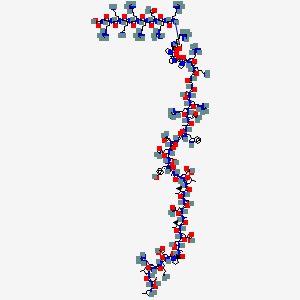
2D structure diagram from NCBI PubChem. This is the actual molecular structure of FOXO4-DRI.
Description
FOXO4-DRI is one of the most scientifically sophisticated peptides in the catalog and represents the cutting edge of senolytic research — the field focused on selectively eliminating senescent cells to combat aging. Senescent cells are cells that have permanently stopped dividing but refuse to die. They accumulate with age and secrete a toxic cocktail of inflammatory cytokines, proteases, and growth factors collectively known as the SASP (senescence-associated secretory phenotype). This SASP drives chronic inflammation, disrupts tissue architecture, impairs stem cell function, and contributes to virtually every age-related disease including atherosclerosis, osteoarthritis, neurodegeneration, fibrosis, and cancer.
The mechanism of FOXO4-DRI is elegant and highly specific. In senescent cells, the transcription factor FOXO4 physically binds to the tumor suppressor protein p53, sequestering p53 in the nucleus and preventing it from triggering apoptosis. This FOXO4-p53 interaction is what keeps senescent cells alive — it's their survival mechanism. FOXO4-DRI is a peptide fragment of FOXO4 that competitively disrupts this interaction: it binds to p53, releasing it from FOXO4's sequestration. The freed p53 then triggers the mitochondrial apoptosis pathway, selectively killing the senescent cell. Crucially, this mechanism is specific to senescent cells — in healthy, non-senescent cells, the FOXO4-p53 interaction is not occurring (p53 is already free and functioning normally), so FOXO4-DRI has no pro-apoptotic effect.
The "DRI" designation stands for "D-Retro-Inverso" — a peptide engineering technique where all L-amino acids are replaced with their D-amino acid mirror images and the sequence is reversed. This conformation preserves the side-chain topology and binding properties of the original L-peptide while rendering it completely resistant to protease degradation (because mammalian proteases cannot recognize or cleave D-amino acid bonds). The result is a peptide with dramatically enhanced stability and in vivo half-life.
In the landmark 2017 Cell publication, de Keizer's group demonstrated that FOXO4-DRI restored fitness (fur density, renal function, exploratory behavior) in both naturally aged and chemotherapy-treated mice, reduced senescent cell burden, and counteracted chemotherapy-induced toxicity — all without apparent side effects.
Clinical Context
FOXO4-DRI is at the frontier of the senolytic drug class, which also includes small molecules like dasatinib + quercetin (D+Q) and navitoclax. The specificity of FOXO4-DRI's mechanism (targeting only senescent cells via the FOXO4-p53 axis) is its key advantage over less selective senolytics. The higher cost ($115.13) reflects the complexity of D-retro-inverso peptide synthesis.
- Highly selective mechanism — does not target non-senescent cells in published studies
- No significant adverse effects reported in mouse studies
- Very limited human data — no clinical trials completed
- The D-retro-inverso configuration means it will not be detected by standard peptide assays designed for L-amino acid peptides
- Expensive to synthesize due to D-amino acid requirements
- Potential concern: clearance of senescent cells could theoretically impair wound healing or tumor suppression in specific contexts (senescence is also a tumor-suppressive mechanism)
- Intermittent dosing protocols are typical in research (periodic clearance cycles, not continuous administration)
Published Research
Published Research & Clinical Data
Peer-reviewed studies and clinical trial data related to FOXO4-DRI
All research below is conducted by independent institutions. MedTech Research Group provides these references for informational purposes only.
Research citations are being compiled for this compound.
Check back soon — our team is curating peer-reviewed sources.
Research Library — 267 Papers
Research data sourced from OpenAlex. CC0 public domain. Articles are the work of their respective authors.
MedTech Research Group provides these references for informational purposes. We do not conduct original research. All studies are the work of their respective authors and institutions.
Cellular Senescence: Defining a Path Forward
Vassilis G. Gorgoulis, Peter D. Adams, Andrea Alimonti, et al. · Cell
Research by Vassilis G. Gorgoulis et al., published in Cell. Not conducted by MedTech Research Group.
Hallmarks of Cellular Senescence
Alejandra Hernandez‐Segura, Jamil Nehme, Marco Demaria · Trends in Cell Biology
Research by Alejandra Hernandez‐Segura et al., published in Trends in Cell Biology. Not conducted by MedTech Research Group.
Cellular senescence and senolytics: the path to the clinic
Selim Chaib, Tamar Tchkonia, James L. Kirkland · Nature Medicine
Research by Selim Chaib et al., published in Nature Medicine. Not conducted by MedTech Research Group.
Senescence and cancer — role and therapeutic opportunities
Clemens A. Schmitt, Boshi Wang, Marco Demaria · Nature Reviews Clinical Oncology
Research by Clemens A. Schmitt et al., published in Nature Reviews Clinical Oncology. Not conducted by MedTech Research Group.
Cellular senescence: a key therapeutic target in aging and diseases
Lei Zhang, Louise E. Pitcher, Matthew J. Yousefzadeh, et al. · Journal of Clinical Investigation
Research by Lei Zhang et al., published in Journal of Clinical Investigation. Not conducted by MedTech Research Group.
Cellular Senescence in Brain Aging
Ewa Sikora, Anna Bielak-Żmijewska, Magdalena Dudkowska, et al. · Frontiers in Aging Neuroscience
Research by Ewa Sikora et al., published in Frontiers in Aging Neuroscience. Not conducted by MedTech Research Group.
The Dual Role of Cellular Senescence in Developing Tumors and Their Response to Cancer Therapy
Markus Schosserer, Johannes Grillari, Michael Breitenbach · Frontiers in Oncology
Research by Markus Schosserer et al., published in Frontiers in Oncology. Not conducted by MedTech Research Group.
Senolytics and senostatics as adjuvant tumour therapy
Susan Short, Edward Fielder, Satomi Miwa, et al. · EBioMedicine
Research by Susan Short et al., published in EBioMedicine. Not conducted by MedTech Research Group.
Senotherapeutics: emerging strategy for healthy aging and age-related disease
Eok-Cheon Kim, Jae‐Ryong Kim · BMB Reports
Research by Eok-Cheon Kim et al., published in BMB Reports. Not conducted by MedTech Research Group.
A review of the pathophysiological mechanisms of doxorubicin-induced cardiotoxicity and aging
Annet N. Linders, Itamar Braga Dias, Teresa López‐Fernández, et al. · npj Aging
Research by Annet N. Linders et al., published in npj Aging. Not conducted by MedTech Research Group.