KissPeptin-10
KissPeptin-10 (Metastin 45-54, KISS1 Decapeptide)
Research Hub — Aggregated Studies
MedTech Research Group aggregates published research from peer-reviewed journals, clinical trials, and academic institutions. We do not conduct original research. All studies cited below are the work of their respective authors and institutions. Sources are linked for verification.
This product is designated FOR RESEARCH USE ONLY (RUO). These compounds have not been approved or cleared under 21 U.S.C. § 505 and have not been evaluated by the FDA for safety, efficacy, or labeling for clinical, diagnostic, or therapeutic use in humans or animals.
MedTech Research Group will only fulfill orders to qualified researchers affiliated with accredited academic institutions, licensed research facilities, or organizations with active IRB/IACUC oversight.
Purchaser Restrictions
- Purchaser must be a qualified researcher at an accredited institution or licensed research facility
- This product may not be sold or redistributed to individual consumers, wellness clinics, health food stores, or retail establishments
- Not intended for human or animal consumption, diagnostic use, or therapeutic application
- Institutional affiliation and research purpose will be verified prior to order fulfillment
Distribution is limited to qualified research use in compliance with applicable federal and state law. These products bear the "For Research Use Only" designation per FDA labeling requirements (minimum 10 pt. font). Ref: 21 U.S.C. § 505; FD&C Act § 201(p) (unapproved new drug definition).
| Risk Tier | YELLOW |
| Category | Anti-Inflammatory / Reproductive |
| Subcategory | HPG Axis Regulation / Anti-Metastatic |
| Pharmacological Class | Peptide Hormone |
| Subclass | GPR54 (KISS1R) Agonist / Gonadotropin-Releasing Hormone Regulator |
| Molecular Type | Synthetic Decapeptide (10 amino acids — the C-terminal active fragment of the 54-AA kisspeptin precursor) |
| Origin | Derived from endogenous kisspeptin (metastin), encoded by the KISS1 gene |
| Regulatory Status | Research Use Only. Not FDA-approved. Active clinical research in reproductive endocrinology (IVF protocols). The KISS1 gene was originally discovered for its anti-metastatic properties. |
| Route of Administration | Subcutaneous injection, intravenous (research) |
| Reconstitution | Lyophilized powder; reconstitute with bacteriostatic water |
| Storage | Refrigerate (2-8°C) |
Chemical Properties
| Molecular Formula | C63H83N17O14 |
| Molecular Weight | 1302.4 g/mol |
| Exact Mass | 1301.63054039 Da |
| InChI Key | RITKWYDZSSQNJI-INXYWQKQSA-N |
| Synonyms |
|
| PubChem | View full record |
Source: NCBI PubChem — public domain data
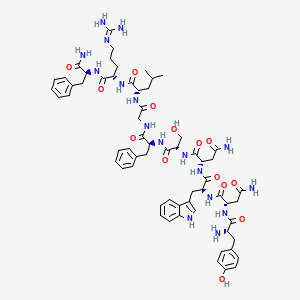
2D structure diagram from NCBI PubChem. This is the actual molecular structure of KissPeptin-10.
Description
KissPeptin-10 is a synthetic decapeptide corresponding to the C-terminal 10 amino acids (amino acids 112-121) of the 145-amino-acid kisspeptin precursor protein, encoded by the KISS1 gene. The KISS1 gene has a remarkable dual history in biomedical research: it was originally discovered in 1996 at the Penn State University College of Medicine (in Hershey, Pennsylvania — hence the name "KISS," as in Hershey's Kisses) as a metastasis-suppressor gene (its protein product was initially called "metastin"). Its role as the master regulator of the reproductive hormone axis was discovered later, in 2003, when loss-of-function mutations in the kisspeptin receptor (GPR54/KISS1R) were found to cause hypogonadotropic hypogonadism — failure of puberty and reproductive function.
KissPeptin-10 acts by binding to and activating the GPR54 receptor (also called KISS1R), a Gq-coupled receptor expressed on GnRH (gonadotropin-releasing hormone) neurons in the hypothalamus. Activation of GPR54 triggers a PLC/IP3/calcium signaling cascade in GnRH neurons, stimulating the release of GnRH, which in turn drives the anterior pituitary to release luteinizing hormone (LH) and follicle-stimulating hormone (FSH). This makes kisspeptin the "master switch" at the top of the hypothalamic-pituitary-gonadal (HPG) axis. In reproductive physiology, kisspeptin integrates metabolic status, circadian rhythm, and stress signals to gate the onset of puberty and regulate fertility throughout adult life.
The anti-metastatic properties of kisspeptin operate through the same GPR54 receptor on cancer cells, where activation suppresses matrix metalloproteinase (MMP) secretion, reduces cell motility and invasion, and inhibits angiogenesis. KISS1/GPR54 expression is downregulated in many metastatic tumors, and re-expression or exogenous kisspeptin administration has been shown to suppress metastasis in animal models of melanoma, breast, ovarian, and pancreatic cancer.
Clinical Context
KissPeptin is being actively investigated in clinical trials as a physiological alternative to traditional GnRH analogs for IVF protocols. In assisted reproduction, the LH surge that triggers oocyte maturation and ovulation is a critical step — traditionally induced by hCG or GnRH agonist triggers. Kisspeptin offers a potentially safer alternative by stimulating the body's own GnRH release, resulting in a more physiological LH surge with lower risk of ovarian hyperstimulation syndrome (OHSS). Clinical trials at Imperial College London have demonstrated successful oocyte maturation and pregnancies using kisspeptin-54 as the trigger in IVF cycles.
- Dual biological role: reproductive axis master regulator AND metastasis suppressor — different applications use the same receptor (GPR54)
- In reproductive applications, kisspeptin stimulates endogenous GnRH release — more physiological than direct GnRH agonist administration
- Rapid tachyphylaxis with continuous administration — pulsatile or intermittent dosing is critical for sustained HPG axis activation
- KissPeptin-10 is the minimal active fragment (decapeptide); the full-length kisspeptin-54 is used in some clinical trials
- The C-terminal amidated Phe residue is essential for GPR54 binding — do not truncate further
- Anti-metastatic applications are distinct from reproductive applications — different dosing and context
- Not a sex hormone — it works upstream of GnRH to regulate the entire HPG axis
Published Research
Published Research & Clinical Data
Peer-reviewed studies and clinical trial data related to KissPeptin-10
2 from PubChem
All research below is conducted by independent institutions. MedTech Research Group provides these references for informational purposes only.
Metastasis suppressor gene KiSS-1 encodes peptide ligand of a G-protein-coupled receptor.
Ohtaki T, Shintani Y, Honda S, Matsumoto H, Hori A, et al.. Nature, 2001.PMID: 11385580
Kotani M, Detheux M, Vandenbogaerde A, Communi D, Vanderwinden JM, et al.. The Journal of biological chemistry, 2001.PMID: 11457843
31 Registered Clinical Trials
Research data sourced from ClinicalTrials.gov. Public domain (U.S. National Library of Medicine).
MedTech Research Group provides these references for informational purposes. We do not conduct original research. All studies are the work of their respective authors and institutions.
31
Total Trials
6
Recruiting
1
Active
19
Completed
Sponsor: Stephanie B. Seminara, MD · Completed: 2030-05
Sponsor: ShangHai Ji Ai Genetics & IVF Institute · Completed: 2020-08-01
Sponsor: Imperial College London · Completed: 2016-10-11
Sponsor: Imperial College London · Completed: 2027-11-30
Sponsor: Massachusetts General Hospital · Completed: 2021-10-22
Research Library — 13,759 Papers
Research data sourced from OpenAlex. CC0 public domain. Articles are the work of their respective authors.
MedTech Research Group provides these references for informational purposes. We do not conduct original research. All studies are the work of their respective authors and institutions.
Per- and Polyfluoroalkyl Substance Toxicity and Human Health Review: Current State of Knowledge and Strategies for Informing Future Research
Suzanne E. Fenton, Alan Ducatman, Alan R. Boobis, et al. · Environmental Toxicology and Chemistry
Research by Suzanne E. Fenton et al., published in Environmental Toxicology and Chemistry. Not conducted by MedTech Research Group.
Oyster reproduction is affected by exposure to polystyrene microplastics
Rossana Sussarellu, Marc Suquet, Yoann Thomas, et al. · Proceedings of the National Academy of Sciences
Research by Rossana Sussarellu et al., published in Proceedings of the National Academy of Sciences. Not conducted by MedTech Research Group.
Childhood Adiposity, Adult Adiposity, and Cardiovascular Risk Factors
Markus Juonala, Costan G. Magnussen, Gerald S. Berenson, et al. · New England Journal of Medicine
Research by Markus Juonala et al., published in New England Journal of Medicine. Not conducted by MedTech Research Group.
Metabolic syndrome: a closer look at the growing epidemic and its associated pathologies
Sadhbh O’Neill, Lorraine O’Driscoll · Obesity Reviews
Research by Sadhbh O’Neill et al., published in Obesity Reviews. Not conducted by MedTech Research Group.
The Metastasis Suppressor Gene KiSS-1 Encodes Kisspeptins, the Natural Ligands of the Orphan G Protein-coupled Receptor GPR54
Masato Kotani, Michel Detheux, Ann L. Vandenbogaerde, et al. · Journal of Biological Chemistry
Research by Masato Kotani et al., published in Journal of Biological Chemistry. Not conducted by MedTech Research Group.
Molecular, spatial, and functional single-cell profiling of the hypothalamic preoptic region
Jeffrey R. Moffitt, Dhananjay Bambah-Mukku, Stephen W. Eichhorn, et al. · Science
Research by Jeffrey R. Moffitt et al., published in Science. Not conducted by MedTech Research Group.
Kisspeptin directly stimulates gonadotropin-releasing hormone release via G protein-coupled receptor 54
Sophie Messager, Emmanouella E. Chatzidaki, Dan Ma, et al. · Proceedings of the National Academy of Sciences
Research by Sophie Messager et al., published in Proceedings of the National Academy of Sciences. Not conducted by MedTech Research Group.
A Role for Kisspeptins in the Regulation of Gonadotropin Secretion in the Mouse
Michelle L. Gottsch, Matthew J. Cunningham, J. T. Smith, et al. · Endocrinology
Research by Michelle L. Gottsch et al., published in Endocrinology. Not conducted by MedTech Research Group.
Metabolomics for Investigating Physiological and Pathophysiological Processes
David S. Wishart · Physiological Reviews
Research by David S. Wishart, published in Physiological Reviews. Not conducted by MedTech Research Group.
Advances in Male Contraception
Stephanie T. Page, John K. Amory, William J. Bremner · Endocrine Reviews
Research by Stephanie T. Page et al., published in Endocrine Reviews. Not conducted by MedTech Research Group.