KPV
KPV (Lys-Pro-Val, Alpha-MSH C-Terminal Tripeptide)
Research Hub — Aggregated Studies
MedTech Research Group aggregates published research from peer-reviewed journals, clinical trials, and academic institutions. We do not conduct original research. All studies cited below are the work of their respective authors and institutions. Sources are linked for verification.
This product is designated FOR RESEARCH USE ONLY (RUO). These compounds have not been approved or cleared under 21 U.S.C. § 505 and have not been evaluated by the FDA for safety, efficacy, or labeling for clinical, diagnostic, or therapeutic use in humans or animals.
MedTech Research Group will only fulfill orders to qualified researchers affiliated with accredited academic institutions, licensed research facilities, or organizations with active IRB/IACUC oversight.
Purchaser Restrictions
- Purchaser must be a qualified researcher at an accredited institution or licensed research facility
- This product may not be sold or redistributed to individual consumers, wellness clinics, health food stores, or retail establishments
- Not intended for human or animal consumption, diagnostic use, or therapeutic application
- Institutional affiliation and research purpose will be verified prior to order fulfillment
Distribution is limited to qualified research use in compliance with applicable federal and state law. These products bear the "For Research Use Only" designation per FDA labeling requirements (minimum 10 pt. font). Ref: 21 U.S.C. § 505; FD&C Act § 201(p) (unapproved new drug definition).
| Risk Tier | GREEN |
| Category | Anti-Inflammatory |
| Subcategory | NFkB Inhibition / GI Anti-Inflammatory |
| Pharmacological Class | Peptide |
| Subclass | Alpha-Melanocyte-Stimulating Hormone C-Terminal Fragment |
| Molecular Type | Synthetic Tripeptide (Lys-Pro-Val, the C-terminal 3 amino acids of alpha-MSH) |
| Origin | Derived from endogenous alpha-melanocyte-stimulating hormone (alpha-MSH); the tripeptide KPV retains anti-inflammatory activity without melanogenic effects |
| Regulatory Status | Research Use Only. Not FDA-approved. Published preclinical data on anti-inflammatory mechanisms. |
| Route of Administration | Subcutaneous injection; oral administration (notable oral bioavailability for a peptide) |
| Reconstitution | Lyophilized powder; reconstitute with bacteriostatic water |
| Storage | Refrigerate (2-8°C) |
Chemical Properties
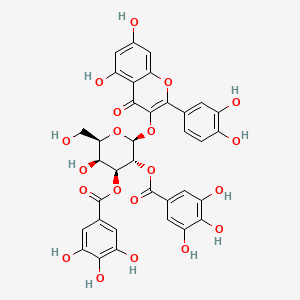
| Molecular Formula | C35H28O20 |
| Molecular Weight | 768.6 g/mol |
| Exact Mass | 768.11739328 Da |
| InChI Key | SDOROZFSWAADKQ-KSDGWNODSA-N |
| Synonyms |
|
| PubChem | View full record |
Source: NCBI PubChem — public domain data
2D structure diagram from NCBI PubChem. This is the actual molecular structure of KPV.
Description
KPV is the C-terminal tripeptide fragment (lysine-proline-valine, amino acids 11-13) of α-melanocyte-stimulating hormone (α-MSH), a 13-amino-acid neuropeptide processed from pro-opiomelanocortin (POMC). α-MSH is well-established as a potent anti-inflammatory peptide, but its clinical use is limited because it also activates melanocortin receptors (particularly MC1R) responsible for melanogenesis (skin darkening) — an undesirable side effect for anti-inflammatory applications. The tripeptide KPV retains the anti-inflammatory activity of the parent α-MSH molecule while lacking any significant melanogenic activity, because the melanocortin receptor binding determinants are located in the central portion of α-MSH (the His-Phe-Arg-Trp pharmacophore, amino acids 6-9), not the C-terminal KPV fragment.
The primary anti-inflammatory mechanism of KPV is the inhibition of the nuclear factor kappa-light-chain-enhancer of activated B cells (NF-κB) signaling pathway — the master transcriptional regulator of inflammatory gene expression. KPV enters cells and directly interacts with IκB kinase (IKK), inhibiting the phosphorylation and subsequent degradation of IκBα. Since IκBα is the cytoplasmic inhibitor that sequesters NF-κB (preventing its nuclear translocation), KPV effectively blocks NF-κB from entering the nucleus and activating the transcription of inflammatory cytokines (TNF-α, IL-1β, IL-6, IL-8), adhesion molecules, and other inflammatory mediators. This mechanism is potent and broad — NF-κB is activated in virtually every inflammatory condition.
A particularly notable property of KPV is its demonstrated oral bioavailability, which is unusual for peptides (most peptides are destroyed in the GI tract). The small size (tripeptide) and the presence of the proline residue (which confers resistance to many digestive peptidases) contribute to this oral stability. This has generated significant research interest in KPV for inflammatory bowel disease (IBD), where oral administration could deliver the peptide directly to inflamed intestinal tissue.
Clinical Context
KPV has emerged as one of the most popular anti-inflammatory peptides in the clinical peptide space, largely due to its well-defined mechanism (NF-κB inhibition), lack of melanogenic side effects, oral bioavailability, and favorable safety profile in published studies. Its application in gastrointestinal inflammation (IBD, colitis, GI permeability disorders) is particularly compelling because oral administration targets the inflamed tissue directly. The tripeptide nature makes it one of the simplest and most cost-effective anti-inflammatory peptides available.
- Anti-inflammatory WITHOUT melanogenic effects — does not cause skin darkening (unlike Melanotan II, which targets MC1R)
- Oral bioavailability is a distinctive advantage for GI applications — unusual for a peptide
- NF-kB inhibition is the primary mechanism — this is a broad anti-inflammatory pathway
- Very well-tolerated with minimal reported adverse effects
- Small tripeptide structure = low production cost ($26.68/10mg)
- May be combined with other GI support agents (glutamine, probiotics) in research protocols
- Not an analgesic — anti-inflammatory effects may take days to weeks to manifest clinically
- The proline residue contributes to peptidase resistance and structural rigidity
Published Research
Published Research & Clinical Data
Peer-reviewed studies and clinical trial data related to KPV
All research below is conducted by independent institutions. MedTech Research Group provides these references for informational purposes only.
Research citations are being compiled for this compound.
Check back soon — our team is curating peer-reviewed sources.
Research Library — 244 Papers
Research data sourced from OpenAlex. CC0 public domain. Articles are the work of their respective authors.
MedTech Research Group provides these references for informational purposes. We do not conduct original research. All studies are the work of their respective authors and institutions.
Antimicrobial Peptides for Therapeutic Applications: A Review
Min‐Duk Seo, Hyung‐Sik Won, Ji Hun Kim, et al. · Molecules
Research by Min‐Duk Seo et al., published in Molecules. Not conducted by MedTech Research Group.
Hyaluronic Acid: A Key Ingredient in the Therapy of Inflammation
Andreia Marinho, Cláudia Nunes, Salette Reis · Biomolecules
Research by Andreia Marinho et al., published in Biomolecules. Not conducted by MedTech Research Group.
Gut microbiota and cardiovascular disease: opportunities and challenges
Negin Kazemian, Morteza Mahmoudi, Frank Halperin, et al. · Microbiome
Research by Negin Kazemian et al., published in Microbiome. Not conducted by MedTech Research Group.
Small-molecule fluorescence-based probes for interrogating major organ diseases
Hai‐Hao Han, He Tian, Yi Zang, et al. · Chemical Society Reviews
Research by Hai‐Hao Han et al., published in Chemical Society Reviews. Not conducted by MedTech Research Group.
Drug-Loaded Nanoparticles Targeted to the Colon With Polysaccharide Hydrogel Reduce Colitis in a Mouse Model
Hamed Laroui, Guillaume Dalmasso, Hang Thi Thu Nguyen, et al. · Gastroenterology
Research by Hamed Laroui et al., published in Gastroenterology. Not conducted by MedTech Research Group.
Nanomedicine for drug targeting: strategies beyond the enhanced permeability and retention effect
Khaled Greish, Hayley Nehoff, Neha N. Parayath, et al. · International Journal of Nanomedicine
Research by Khaled Greish et al., published in International Journal of Nanomedicine. Not conducted by MedTech Research Group.
Recent Advances in Protein and Peptide Drug Delivery: A Special Emphasis on Polymeric Nanoparticles
Ashaben Patel, Mitesh Patel, Xiaoyan Yang, et al. · Protein and Peptide Letters
Research by Ashaben Patel et al., published in Protein and Peptide Letters. Not conducted by MedTech Research Group.
CXCL12-CXCR4/CXCR7 Axis in Cancer: from Mechanisms to Clinical Applications
Yaru Yang, Jiayan Li, Wangrui Lei, et al. · International Journal of Biological Sciences
Research by Yaru Yang et al., published in International Journal of Biological Sciences. Not conducted by MedTech Research Group.
New Insights into the Functions of α‐MSH and Related Peptides in the Immune System
Thomas A. Luger, Thomas Scholzen, Thomas Brzoska, et al. · Annals of the New York Academy of Sciences
Research by Thomas A. Luger et al., published in Annals of the New York Academy of Sciences. Not conducted by MedTech Research Group.
<p>Nanoparticle-Mediated Drug Delivery Systems For The Treatment Of IBD: Current Perspectives</p>
Chunhua Yang, Didier Merlin · International Journal of Nanomedicine
Research by Chunhua Yang et al., published in International Journal of Nanomedicine. Not conducted by MedTech Research Group.