MOTS-c
MOTS-c (Mitochondrial ORF of the Twelve S rRNA type-c)
Research Hub — Aggregated Studies
MedTech Research Group aggregates published research from peer-reviewed journals, clinical trials, and academic institutions. We do not conduct original research. All studies cited below are the work of their respective authors and institutions. Sources are linked for verification.
This product is designated FOR RESEARCH USE ONLY (RUO). These compounds have not been approved or cleared under 21 U.S.C. § 505 and have not been evaluated by the FDA for safety, efficacy, or labeling for clinical, diagnostic, or therapeutic use in humans or animals.
MedTech Research Group will only fulfill orders to qualified researchers affiliated with accredited academic institutions, licensed research facilities, or organizations with active IRB/IACUC oversight.
Purchaser Restrictions
- Purchaser must be a qualified researcher at an accredited institution or licensed research facility
- This product may not be sold or redistributed to individual consumers, wellness clinics, health food stores, or retail establishments
- Not intended for human or animal consumption, diagnostic use, or therapeutic application
- Institutional affiliation and research purpose will be verified prior to order fulfillment
Distribution is limited to qualified research use in compliance with applicable federal and state law. These products bear the "For Research Use Only" designation per FDA labeling requirements (minimum 10 pt. font). Ref: 21 U.S.C. § 505; FD&C Act § 201(p) (unapproved new drug definition).
| Risk Tier | GREEN |
| Category | Longevity / Metabolic |
| Subcategory | Mitochondrial Signaling, Exercise Mimetic, Metabolic Regulation |
| Pharmacological Class | Mitochondrial-Derived Peptide (MDP) |
| Subclass | Mitochondrial ORF Peptide |
| Molecular Type | Peptide (16 amino acids, encoded by mitochondrial DNA — 12S rRNA gene) |
| Origin | Endogenous — encoded in mitochondrial DNA, making it one of a small number of peptides encoded outside the nuclear genome. Discovered in 2015 by Dr. Pinchas Cohen's lab at USC. |
| Regulatory Status | Research Use Only. Not FDA-approved. Relatively recently discovered (2015). |
| Route of Administration | Subcutaneous injection, intraperitoneal (research) |
| Reconstitution | Lyophilized powder; reconstitute with bacteriostatic water |
| Storage | Refrigerate (2-8°C) |
Chemical Properties
| Molecular Formula | C101H152N28O22S2 |
| Molecular Weight | 2174.6 g/mol |
| Exact Mass | 2174.1110958 Da |
| InChI Key | WYTHCOXVWRKRAH-LOKRTKBUSA-N |
| Synonyms |
|
| PubChem | View full record |
Source: NCBI PubChem — public domain data
Bioactivity Data
5 assay results from ChEMBL CHEMBL3350556
| CC50 | 1.1k nM | CEM-SS | Homo sapiens |
| IC50 | 28.8k nM | Protein kinase C (PKC) | Homo sapiens |
| IC50 | 125.0k nM | P388 | Mus musculus |
| IC50 | 3.0k nM | P388CPT5 | Mus musculus |
| IC50 | 360.00 nM | CEM-SS | Homo sapiens |
Data from EMBL-EBI ChEMBL. CC BY-SA 3.0.
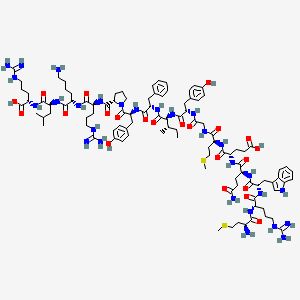
2D structure diagram from NCBI PubChem. This is the actual molecular structure of MOTS-c.
Description
MOTS-c is a groundbreaking discovery in peptide biology — a 16-amino-acid peptide encoded within the mitochondrial genome (specifically within the 12S rRNA gene), making it one of only a handful of known mitochondrial-derived peptides (MDPs). Its discovery in 2015 by Dr. Pinchas Cohen and colleagues at the University of Southern California challenged the prevailing understanding that mitochondrial DNA primarily encodes structural components of the electron transport chain. MOTS-c demonstrated that mitochondria also produce bioactive signaling peptides that regulate nuclear gene expression — a form of mitochondrial-to-nuclear communication called retrograde signaling.
MOTS-c functions as an exercise mimetic and metabolic regulator. Its primary mechanism involves activation of the AMPK (AMP-activated protein kinase) pathway — the same master metabolic switch activated by exercise, caloric restriction, and the diabetes drug metformin. AMPK activation by MOTS-c increases cellular glucose uptake (independently of insulin), enhances fatty acid oxidation, stimulates mitochondrial biogenesis, and shifts cellular metabolism toward a more efficient, oxidative state. During metabolic stress (such as exercise), MOTS-c translocates from the cytoplasm into the cell nucleus, where it interacts with transcription factors to regulate the expression of antioxidant response element (ARE)-containing genes — essentially activating the cell's stress defense programs.
In mouse models, MOTS-c administration has demonstrated remarkable effects: prevention of age-related and high-fat-diet-induced obesity, improved insulin sensitivity, enhanced exercise capacity, improved physical performance in aged mice, and extended healthspan. Perhaps most strikingly, MOTS-c levels naturally decline with age in both mice and humans, and this decline correlates with the age-related metabolic dysfunction (insulin resistance, increased visceral fat, reduced exercise capacity) that MOTS-c supplementation can reverse.
Clinical Context
MOTS-c is one of the most scientifically compelling peptides in the longevity research space due to its unique mitochondrial origin and its function as an endogenous exercise mimetic. The clinical interest is particularly high for populations unable to exercise adequately (elderly, disabled, post-surgical) and for metabolic disease where exercise would be beneficial but adherence is challenging.
The 10mg vial (YPB.227) offers the highest margin in the entire catalog — 86.7% at MSRP, with a cost of only $26.68 for a $200 MSRP product.
- Relatively new discovery (2015) — limited human data
- Animal studies have shown excellent tolerability with no reported significant adverse effects
- As a mitochondrial-encoded peptide, MOTS-c levels vary between individuals based on mitochondrial DNA variants (haplogroups), potentially explaining population differences in metabolic disease susceptibility
- May potentiate the effects of exercise — research suggests additive benefits when combined with physical activity
- Potential interaction with metformin (shared AMPK activation pathway) — effects may be additive or redundant
Research data sourced from UniProt. CC BY 4.0 — attribution required.
MedTech Research Group provides these references for informational purposes. We do not conduct original research. All studies are the work of their respective authors and institutions.
Biological Function
Regulates insulin sensitivity and metabolic homeostasis (PubMed:25738459, PubMed:33468709). Inhibits the folate cycle, thereby reducing de novo purine biosynthesis which leads to the accumulation of the de novo purine synthesis intermediate 5-aminoimidazole-4-carboxamide (AICAR) and the activation of the metabolic regulator 5'-AMP-activated protein kinase (AMPK) (PubMed:25738459). Protects against age-dependent and diet-induced insulin resistance as well as diet-induced obesity (PubMed:25738459). In response to metabolic stress, translocates to the nucleus where it binds to antioxidant response elements (ARE) present in the promoter regions of a number of genes and plays a role in regulating nuclear gene expression in an NFE2L2-dependent manner and increasing cellular resistance to metabolic stress (PubMed:29983246). Increases mitochondrial respiration and levels of CPT1A and cytokines IL1B, IL6, IL8, IL10 and TNF in senescent cells (PubMed:29886458). Increases activity of the serine/threonine protein kinase complex mTORC2 and reduces activity of the PTEN phosphatase, thus promoting phosphorylation of AKT (PubMed:33554779). This promotes AKT-mediated phosphorylation of transcription factor FOXO1 which reduces FOXO1 activity, leading to reduced levels of MSTN and promotion of skeletal muscle growth (PubMed:33554779). Promotes osteogenic differentiation of bone marrow mesenchymal stem cells via the TGFB/SMAD pathway (PubMed:30468456). Promotes osteoblast proliferation and osteoblast synthesis of type I collagens COL1A1 and COL1A2 via the TGFB/SMAD pathway (PubMed:31081069)
Tissue Expression
Detected in plasma (at protein level) (PubMed:25738459, PubMed:32182209). Also expressed in skeletal muscle (at protein level) (PubMed:32182209)
Subcellular Location
Secreted; Mitochondrion; Nucleus
Amino acid sequence length: 16 residues
Published Research
Published Research & Clinical Data
Peer-reviewed studies and clinical trial data related to MOTS-c
All research below is conducted by independent institutions. MedTech Research Group provides these references for informational purposes only.
Research citations are being compiled for this compound.
Check back soon — our team is curating peer-reviewed sources.
3 Registered Clinical Trials
Research data sourced from ClinicalTrials.gov. Public domain (U.S. National Library of Medicine).
MedTech Research Group provides these references for informational purposes. We do not conduct original research. All studies are the work of their respective authors and institutions.
3
Total Trials
2
Recruiting
0
Active
0
Completed
Sponsor: University of Athens · Completed: 2027-06-30
Sponsor: University of Athens · Completed: 2021-12-31
Sponsor: Hudson Biotech · Completed: 2028-05-17
Research Library — 3,630 Papers
Research data sourced from OpenAlex. CC0 public domain. Articles are the work of their respective authors.
MedTech Research Group provides these references for informational purposes. We do not conduct original research. All studies are the work of their respective authors and institutions.
Transfer of proteins across membranes. I. Presence of proteolytically processed and unprocessed nascent immunoglobulin light chains on membrane-bound ribosomes of murine myeloma.
Günter Blobel, B Dobberstein · The Journal of Cell Biology
Research by Günter Blobel et al., published in The Journal of Cell Biology. Not conducted by MedTech Research Group.
Mechanisms of cytochrome c release from mitochondria
Carmen Garrido, Lorenzo Galluzzi, Mathilde Brunet, et al. · Cell Death and Differentiation
Research by Carmen Garrido et al., published in Cell Death and Differentiation. Not conducted by MedTech Research Group.
Chaperone-mediated coupling of endoplasmic reticulum and mitochondrial Ca2+ channels
György Szabadkai, Katiuscia Bianchi, Péter Várnai, et al. · The Journal of Cell Biology
Research by György Szabadkai et al., published in The Journal of Cell Biology. Not conducted by MedTech Research Group.
Plant and mycorrhizal regulation of rhizodeposition
Davey L. Jones, Angela Hodge, Yakov Kuzyakov · New Phytologist
Research by Davey L. Jones et al., published in New Phytologist. Not conducted by MedTech Research Group.
Age and Age-Related Diseases: Role of Inflammation Triggers and Cytokines
Irene Maeve Rea, David S. Gibson, Victoria McGilligan, et al. · Frontiers in Immunology
Research by Irene Maeve Rea et al., published in Frontiers in Immunology. Not conducted by MedTech Research Group.
Yeast and bacterial modulation of wine aroma and flavour
Jan H. Swiegers, Eveline Bartowsky, Paul A. Henschke, et al. · Australian Journal of Grape and Wine Research
Research by Jan H. Swiegers et al., published in Australian Journal of Grape and Wine Research. Not conducted by MedTech Research Group.
Muscle–Organ Crosstalk: The Emerging Roles of Myokines
Mai Charlotte Krogh Severinsen, Bente Klarlund Pedersen · Endocrine Reviews
Research by Mai Charlotte Krogh Severinsen et al., published in Endocrine Reviews. Not conducted by MedTech Research Group.
Ghrelin
Timo D. Müller, Rubén Nogueiras, Mark L. Andermann, et al. · Molecular Metabolism
Research by Timo D. Müller et al., published in Molecular Metabolism. Not conducted by MedTech Research Group.
The Effects of Acute Exercise on Mood, Cognition, Neurophysiology, and Neurochemical Pathways: A Review
Julia C. Basso, Wendy Suzuki · Brain Plasticity
Research by Julia C. Basso et al., published in Brain Plasticity. Not conducted by MedTech Research Group.
Targeting copper in cancer therapy: ‘Copper That Cancer’
Delphine Denoyer, Shashank Masaldan, Sharon La Fontaine, et al. · Metallomics
Research by Delphine Denoyer et al., published in Metallomics. Not conducted by MedTech Research Group.