PNC-27
PNC-27 (p53-Derived Membrane-Lytic Anti-Cancer Peptide)
Research Hub — Aggregated Studies
MedTech Research Group aggregates published research from peer-reviewed journals, clinical trials, and academic institutions. We do not conduct original research. All studies cited below are the work of their respective authors and institutions. Sources are linked for verification.
This product is designated FOR RESEARCH USE ONLY (RUO). These compounds have not been approved or cleared under 21 U.S.C. § 505 and have not been evaluated by the FDA for safety, efficacy, or labeling for clinical, diagnostic, or therapeutic use in humans or animals.
MedTech Research Group will only fulfill orders to qualified researchers affiliated with accredited academic institutions, licensed research facilities, or organizations with active IRB/IACUC oversight.
Purchaser Restrictions
- Purchaser must be a qualified researcher at an accredited institution or licensed research facility
- This product may not be sold or redistributed to individual consumers, wellness clinics, health food stores, or retail establishments
- Not intended for human or animal consumption, diagnostic use, or therapeutic application
- Institutional affiliation and research purpose will be verified prior to order fulfillment
Distribution is limited to qualified research use in compliance with applicable federal and state law. These products bear the "For Research Use Only" designation per FDA labeling requirements (minimum 10 pt. font). Ref: 21 U.S.C. § 505; FD&C Act § 201(p) (unapproved new drug definition).
| Risk Tier | YELLOW |
| Category | Anti-Cancer |
| Subcategory | Selective Cancer Cell Lysis |
| Pharmacological Class | Peptide |
| Subclass | p53-Derived Membrane-Lytic Anti-Cancer Peptide |
| Molecular Type | Synthetic Peptide (composed of amino acids 12-26 of the p53 tumor suppressor protein fused to an HDM-2 binding domain / membrane-penetrating leader sequence) |
| Origin | Synthetic — designed by Dr. Ehsan Ehsanipour and colleagues; based on the p53 transactivation domain that interacts with HDM-2 (MDM2) |
| Regulatory Status | Research Use Only. Not FDA-approved. Published preclinical data in cancer cell biology. |
| Route of Administration | Subcutaneous injection (peri-tumoral or systemic, research) |
| Reconstitution | Lyophilized powder; reconstitute with bacteriostatic water |
| Storage | Refrigerate (2-8°C) |
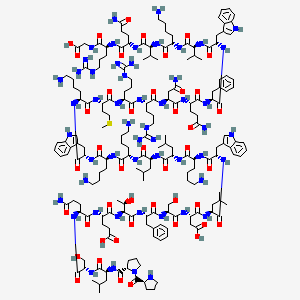
2D structure diagram from NCBI PubChem. This is the actual molecular structure of PNC-27.
Description
PNC-27 is a synthetic anti-cancer peptide designed to selectively kill cancer cells while leaving normal cells unharmed. Its mechanism is based on the interaction between the tumor suppressor protein p53 and its negative regulator HDM-2 (human double minute 2, also known as MDM2 in mice). In normal cells, HDM-2 is located intracellularly where it binds p53, ubiquitinating it for proteasomal degradation — this is the normal feedback mechanism that prevents excessive p53 activity. However, in many cancer cell types, HDM-2 is overexpressed and, critically, is also aberrantly localized to the cell membrane surface — a location where it is not found in normal cells. This cancer-specific membrane HDM-2 expression is the key vulnerability that PNC-27 exploits.
PNC-27 consists of a sequence derived from amino acids 12-26 of the p53 protein (the region of p53 that normally binds to HDM-2's hydrophobic binding pocket) attached to a membrane-penetrating leader sequence. When PNC-27 encounters cancer cells with surface-expressed HDM-2, it binds to the HDM-2 protein on the cell membrane surface. This binding event triggers the formation of transmembrane pores — physical holes in the cancer cell membrane — through an oligomerization process. These pores destroy the membrane integrity of the cancer cell, causing rapid lysis and cell death through a necrotic (not apoptotic) mechanism. Because normal cells do not express HDM-2 on their membrane surface, PNC-27 has no binding target on normal cells and therefore does not affect them.
Published preclinical studies have demonstrated PNC-27's selective cytotoxicity against multiple cancer cell lines, including breast cancer (MDA-MB-231, MCF-7), pancreatic cancer (MIA PaCa-2), leukemia, lymphoma, melanoma, and colon cancer cell lines — all while showing no toxicity to normal cells in the same culture conditions. The mechanism is rapid (cell lysis occurs within hours) and does not require the cancer cell to have functional p53 — the peptide targets membrane HDM-2 regardless of the cancer cell's p53 status.
Clinical Context
PNC-27 represents a novel approach to cancer therapy that exploits a cancer-specific membrane marker (surface HDM-2) rather than targeting rapidly dividing cells (like conventional chemotherapy) or specific oncogenic mutations (like targeted therapy). The selectivity for cancer cells is its most compelling feature, as it potentially avoids the devastating side effects of non-selective cytotoxic chemotherapy. However, PNC-27 remains in the preclinical stage — no clinical trials in humans have been completed. The cost ($33.59 at cost, $220 MSRP) reflects both the specialized synthesis and the high-value positioning.
- PRECLINICAL ONLY — no completed human clinical trials; all data is from cell culture and animal models
- Mechanism is selective for cancer cells expressing HDM-2 on the cell surface — normal cells are not affected in published studies
- Kills cancer cells through necrosis (membrane lysis), not apoptosis — different from most anti-cancer agents
- Does NOT require functional p53 in the cancer cell — effective regardless of p53 mutation status
- Not all cancers overexpress surface HDM-2 — efficacy depends on this cancer-specific marker
- The necrotic cell death mechanism could theoretically cause inflammation at tumor sites (release of intracellular contents)
- Route of administration, optimal dosing, and pharmacokinetics in humans are not established
- High MSRP margin ($33.59 cost to $220 MSRP) reflects specialized oncology positioning
- This is a research tool, not an approved cancer treatment — do not present as a clinical therapy
Published Research
Published Research & Clinical Data
Peer-reviewed studies and clinical trial data related to PNC-27
All research below is conducted by independent institutions. MedTech Research Group provides these references for informational purposes only.
Research citations are being compiled for this compound.
Check back soon — our team is curating peer-reviewed sources.
Research Library — 233 Papers
Research data sourced from OpenAlex. CC0 public domain. Articles are the work of their respective authors.
MedTech Research Group provides these references for informational purposes. We do not conduct original research. All studies are the work of their respective authors and institutions.
Cerium oxide nanoparticle: a remarkably versatile rare earth nanomaterial for biological applications
Can Xu, Xiaogang Qu · NPG Asia Materials
Research by Can Xu et al., published in NPG Asia Materials. Not conducted by MedTech Research Group.
A review of drug delivery systems based on nanotechnology and green chemistry: green nanomedicine
Hossein Jahangirian, Ensieh Ghasemian Lemraski, Thomas J. Webster, et al. · International Journal of Nanomedicine
Research by Hossein Jahangirian et al., published in International Journal of Nanomedicine. Not conducted by MedTech Research Group.
Evaluation of the use of therapeutic peptides for cancer treatment
Susan Marqus, Elena Pirogova, Terrence J. Piva · Journal of Biomedical Science
Research by Susan Marqus et al., published in Journal of Biomedical Science. Not conducted by MedTech Research Group.
Poly(N-isopropylacrylamide) and Copolymers: A Review on Recent Progresses in Biomedical Applications
Sonia Lanzalaco, Elaine Armelín · Gels
Research by Sonia Lanzalaco et al., published in Gels. Not conducted by MedTech Research Group.
Engineered exosomes from different sources for cancer-targeted therapy
Menghui Zhang, Shengyun Hu, Lin Liu, et al. · Signal Transduction and Targeted Therapy
Research by Menghui Zhang et al., published in Signal Transduction and Targeted Therapy. Not conducted by MedTech Research Group.
Calcium carbonate: controlled synthesis, surface functionalization, and nanostructured materials
Yuqin Niu, Jiahui Liu, Cyril Aymonier, et al. · Chemical Society Reviews
Research by Yuqin Niu et al., published in Chemical Society Reviews. Not conducted by MedTech Research Group.
<p>Curcumin-loaded nanoparticles: a novel therapeutic strategy in treatment of central nervous system disorders</p>
Hanie Yavarpour‐Bali, Maryam Ghasemi‐Kasman, Marzieh Pirzadeh · International Journal of Nanomedicine
Research by Hanie Yavarpour‐Bali et al., published in International Journal of Nanomedicine. Not conducted by MedTech Research Group.
Ribosome Biogenesis: A Central Player in Cancer Metastasis and Therapeutic Resistance
Amr R. Elhamamsy, Brandon J. Metge, Heba A. Alsheikh, et al. · Cancer Research
Research by Amr R. Elhamamsy et al., published in Cancer Research. Not conducted by MedTech Research Group.
Microneedle array systems for long-acting drug delivery
Lalitkumar K. Vora, Kurtis Moffatt, Ismaiel A. Tekko, et al. · European Journal of Pharmaceutics and Biopharmaceutics
Research by Lalitkumar K. Vora et al., published in European Journal of Pharmaceutics and Biopharmaceutics. Not conducted by MedTech Research Group.
Extracellular vesicles: a rising star for therapeutics and drug delivery
Shuang Du, Yucheng Guan, Aihua Xie, et al. · Journal of Nanobiotechnology
Research by Shuang Du et al., published in Journal of Nanobiotechnology. Not conducted by MedTech Research Group.