Snap-8
Snap-8 (Acetyl Octapeptide-3)
Research Hub — Aggregated Studies
MedTech Research Group aggregates published research from peer-reviewed journals, clinical trials, and academic institutions. We do not conduct original research. All studies cited below are the work of their respective authors and institutions. Sources are linked for verification.
This product is designated FOR RESEARCH USE ONLY (RUO). These compounds have not been approved or cleared under 21 U.S.C. § 505 and have not been evaluated by the FDA for safety, efficacy, or labeling for clinical, diagnostic, or therapeutic use in humans or animals.
MedTech Research Group will only fulfill orders to qualified researchers affiliated with accredited academic institutions, licensed research facilities, or organizations with active IRB/IACUC oversight.
Purchaser Restrictions
- Purchaser must be a qualified researcher at an accredited institution or licensed research facility
- This product may not be sold or redistributed to individual consumers, wellness clinics, health food stores, or retail establishments
- Not intended for human or animal consumption, diagnostic use, or therapeutic application
- Institutional affiliation and research purpose will be verified prior to order fulfillment
Distribution is limited to qualified research use in compliance with applicable federal and state law. These products bear the "For Research Use Only" designation per FDA labeling requirements (minimum 10 pt. font). Ref: 21 U.S.C. § 505; FD&C Act § 201(p) (unapproved new drug definition).
| Risk Tier | GREEN |
| Category | Skin / Cosmetic |
| Subcategory | Anti-Wrinkle, Neurocosmetic |
| Pharmacological Class | Peptide |
| Subclass | Neuromuscular Inhibitor Peptide (SNAP-25 fragment analog) |
| Molecular Type | Synthetic Octapeptide (8 amino acids, acetylated) |
| Origin | Synthetic — designed to mimic a fragment of SNAP-25, a protein in the SNARE complex involved in neurotransmitter release |
| Regulatory Status | Widely used in topical cosmetic products. Research Use Only as injectable. |
| Route of Administration | Topical (cosmetic), subcutaneous injection (research) |
| Reconstitution | Lyophilized powder; reconstitute with bacteriostatic water |
| Storage | Refrigerate (2-8°C) |
Chemical Properties
| Molecular Formula | C7H14ClNO2 |
| Molecular Weight | 179.64 g/mol |
| Exact Mass | 179.0713064 Da |
| InChI Key | VXBPZOLCIITMPB-UHFFFAOYSA-N |
| Synonyms |
|
| PubChem | View full record |
Source: NCBI PubChem — public domain data
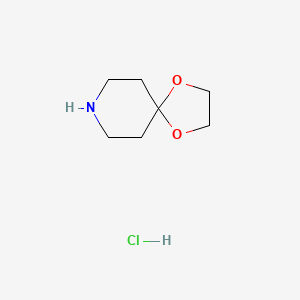
2D structure diagram from NCBI PubChem. This is the actual molecular structure of Snap-8.
Description
Snap-8, formally known as Acetyl Octapeptide-3 (trade name SNAP-8 by Lipotec/Lubrizol), is a synthetic octapeptide designed as a topical "Botox alternative." The name derives from its mechanism: it is modeled after a fragment of SNAP-25, one of three proteins that form the SNARE complex — the molecular machinery responsible for vesicle fusion and neurotransmitter release at the neuromuscular junction.
Botulinum toxin (Botox) works by cleaving SNARE complex proteins, thereby preventing acetylcholine release and causing muscle paralysis. Snap-8 mimics this effect through a different, non-toxic mechanism: it acts as a competitive inhibitor of the SNARE complex assembly. By competing with native SNAP-25 for incorporation into the SNARE complex, Snap-8 destabilizes the complex and reduces — but does not eliminate — vesicle fusion and neurotransmitter release. The result is a partial reduction in muscle contraction at the application site, softening expression lines and dynamic wrinkles (crow's feet, forehead lines, glabellar frown lines) without the complete paralysis or injection-site risks associated with botulinum toxin.
Snap-8 is actually an elongated version of the earlier peptide Argireline (Acetyl Hexapeptide-3/SNAP-6), with two additional amino acids that improve its SNARE complex binding affinity. Studies have demonstrated that Snap-8 at 10% concentration reduced wrinkle depth by approximately 63% over 28 days of topical application — comparable to or exceeding the performance of Argireline.
Clinical Context
Snap-8 is one of the most commercially successful cosmetic peptides in the skincare industry. It appears in hundreds of anti-aging products globally. While its injectable form is less commonly studied, the research community has explored subcutaneous delivery for more pronounced effects than topical application can achieve. The extremely low cost ($20.81) and high margin (79.2%) make this an attractive product for the cosmetic peptide market.
- Topical Snap-8 has an excellent safety profile with extensive cosmetic use
- Injectable Snap-8 has limited clinical safety data
- Unlike Botox, Snap-8 produces partial (not complete) neurotransmitter reduction — effects are subtler and reversible
- No risk of ptosis, asymmetry, or muscle atrophy associated with botulinum toxin
- Onset of topical effects: gradual over 2-4 weeks (vs. 3-7 days for Botox)
- Duration: requires ongoing application to maintain effects (no "wearing off" period like Botox's 3-4 months)
Published Research
Published Research & Clinical Data
Peer-reviewed studies and clinical trial data related to Snap-8
All research below is conducted by independent institutions. MedTech Research Group provides these references for informational purposes only.
Research citations are being compiled for this compound.
Check back soon — our team is curating peer-reviewed sources.
Research Library — 69 Papers
Research data sourced from OpenAlex. CC0 public domain. Articles are the work of their respective authors.
MedTech Research Group provides these references for informational purposes. We do not conduct original research. All studies are the work of their respective authors and institutions.
Regulation of adipocyte lipolysis
Gema Frühbeck, Leire Méndez-Giménez, José Antonio Fernández‐Formoso, et al. · Nutrition Research Reviews
Research by Gema Frühbeck et al., published in Nutrition Research Reviews. Not conducted by MedTech Research Group.
A Global Review on Short Peptides: Frontiers and Perspectives
Vasso Apostolopoulos, Joanna Bojarska, Tsun‐Thai Chai, et al. · Molecules
Research by Vasso Apostolopoulos et al., published in Molecules. Not conducted by MedTech Research Group.
Review of applications of microneedling in dermatology
Christopher Iriarte, Olabola Awosika, Mónica Rengifo‐Pardo, et al. · Clinical Cosmetic and Investigational Dermatology
Research by Christopher Iriarte et al., published in Clinical Cosmetic and Investigational Dermatology. Not conducted by MedTech Research Group.
Profiling constitutive proteolytic events <i>in vivo</i>
John C. Timmer, Mari Enoksson, Eric Wildfang, et al. · Biochemical Journal
Research by John C. Timmer et al., published in Biochemical Journal. Not conducted by MedTech Research Group.
Natural Products Diversity of Marine Ascidians (Tunicates; Ascidiacea) and Successful Drugs in Clinical Development
Satheesh Kumar Palanisamy, Natesan Mannangatti Rajendran, Angela Marino · Natural Products and Bioprospecting
Research by Satheesh Kumar Palanisamy et al., published in Natural Products and Bioprospecting. Not conducted by MedTech Research Group.
Constitutive IKK2 activation in acinar cells is sufficient to induce pancreatitis in vivo
Bernd Baumann, Martin Wagner, Tamara Aleksic, et al. · Journal of Clinical Investigation
Research by Bernd Baumann et al., published in Journal of Clinical Investigation. Not conducted by MedTech Research Group.
Trending Anti-Aging Peptides
Marta Ferreira, Maria Catarina Magalhães, José Manuel Sousa Lobo, et al. · Cosmetics
Research by Marta Ferreira et al., published in Cosmetics. Not conducted by MedTech Research Group.
Cosmeceutical Peptides in the Framework of Sustainable Wellness Economy
Fosca Errante, Patrycja Ledwoń, Rafał Latajka, et al. · Frontiers in Chemistry
Research by Fosca Errante et al., published in Frontiers in Chemistry. Not conducted by MedTech Research Group.
Multiple Cis-Acting DNA Regulatory Elements Mediate Hepatic Angiotensinogen Gene Expression
Allan R. Brasier, James E. Tate, David Ron, et al. · Molecular Endocrinology
Research by Allan R. Brasier et al., published in Molecular Endocrinology. Not conducted by MedTech Research Group.
Peptides: Emerging Candidates for the Prevention and Treatment of Skin Senescence: A Review
Andrada Pintea, Andrei Manea, Cezara Pintea, et al. · Biomolecules
Research by Andrada Pintea et al., published in Biomolecules. Not conducted by MedTech Research Group.