Tesamorelin
Research Hub — Aggregated Studies
MedTech Research Group aggregates published research from peer-reviewed journals, clinical trials, and academic institutions. We do not conduct original research. All studies cited below are the work of their respective authors and institutions. Sources are linked for verification.
This product is classified as an FDA-regulated compound under the Federal Food, Drug, and Cosmetic Act (FD&C Act), as amended by the Drug Quality and Security Act (DQSA), Title I — Compounding Quality Act (2013).
MedTech Research Group will only fulfill orders for this compound to state-licensed 503A compounding pharmacies or FDA-registered 503B outsourcing facilities that maintain current registration with the U.S. Food and Drug Administration.
Verification Requirements
- Valid state pharmacy license (verified against state board of pharmacy records)
- Current state licensure (503A) or FDA registration (503B) verified via the appropriate state board of pharmacy or FDA Drug Establishment Registration database
- DEA registration (if applicable to the compound)
- Compliance with current Good Manufacturing Practice (cGMP) per 21 CFR Parts 210 and 211
This product may not be sold to consumers, wellness clinics, health stores, or any entity not licensed as a compounding pharmacy. Orders will not be fulfilled until licensure verification is complete. Ref: 21 U.S.C. §§ 353a, 353b; FDA Guidance for Industry: Mixing, Diluting, or Repackaging Biological Products (2025).
| Risk Tier | RED |
| Category | Growth Hormone Axis |
| Subcategory | GH Secretagogue (GHRH Analog) |
| Pharmacological Class | Peptide Hormone Analog |
| Subclass | Full-Length Growth Hormone-Releasing Hormone Analog |
| Molecular Type | Synthetic Peptide (44 amino acids — full-length GHRH with trans-3-hexenoic acid modification) |
| Origin | Synthetic analog of endogenous GHRH with N-terminal modification |
| Regulatory Status | FDA-approved as Egrifta (tesamorelin for injection) for reduction of excess abdominal fat in HIV-infected patients with lipodystrophy (2010). |
| Route of Administration | Subcutaneous injection |
| Reconstitution | Lyophilized powder; reconstitute with bacteriostatic water |
| Storage | Refrigerate (2-8°C) before and after reconstitution |
Chemical Properties
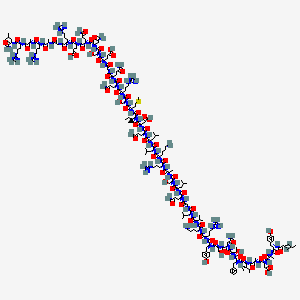
| Molecular Formula | C221H366N72O67S |
| Molecular Weight | 5136 g/mol |
| Exact Mass | 5134.7233503 Da |
| InChI Key | QBEPNUQJQWDYKU-BMGKTWPMSA-N |
| Synonyms |
|
| PubChem | View full record |
Source: NCBI PubChem — public domain data
2D structure diagram from NCBI PubChem. This is the actual molecular structure of Tesamorelin.
Description
Tesamorelin is a synthetic analog of the full-length 44-amino-acid human growth hormone-releasing hormone (GHRH), modified by the addition of a trans-3-hexenoic acid group to the N-terminal tyrosine residue. This modification protects the peptide from rapid enzymatic degradation by dipeptidyl peptidase IV (DPP-IV), which normally cleaves native GHRH between positions 2 and 3, rendering it inactive. The result is a GHRH analog with improved stability and a more sustained pharmacological profile compared to both native GHRH and the truncated analog sermorelin.
Like sermorelin, tesamorelin acts by binding to GHRH receptors on anterior pituitary somatotroph cells, stimulating pulsatile growth hormone release through the Gs/cAMP signaling pathway. However, tesamorelin's full-length structure and N-terminal modification confer greater potency and a longer duration of action. The pituitary feedback regulation through somatostatin and IGF-1 remains intact. In the pivotal clinical trials leading to FDA approval, tesamorelin significantly reduced visceral adipose tissue (VAT) by an average of 15-18% in HIV-infected patients with lipodystrophy — a condition characterized by abnormal fat redistribution (excess visceral fat with peripheral fat wasting) as a side effect of antiretroviral therapy. Importantly, these reductions in visceral fat were accompanied by improvements in lipid profiles (reduced triglycerides, improved HDL/LDL ratios) and patient-reported improvements in body image.
Clinical Context
Tesamorelin is the only GHRH analog currently FDA-approved for a therapeutic indication (visceral fat reduction in HIV lipodystrophy, as Egrifta). This regulatory approval provides a robust safety database and established dosing protocols. The clinical significance of visceral fat reduction extends beyond HIV lipodystrophy — visceral adiposity is independently associated with insulin resistance, type 2 diabetes, cardiovascular disease, and non-alcoholic fatty liver disease (NAFLD). Emerging research has explored tesamorelin's potential for NAFLD/NASH, with promising results showing reductions in hepatic fat fraction and improvements in liver fibrosis markers. The FDA-approved dose is 2mg subcutaneously daily.
- FDA-approved for HIV lipodystrophy (Egrifta) — extensive human safety data available
- Contraindicated in patients with active malignancy, disruption of the hypothalamic-pituitary axis (e.g., pituitary surgery, radiation, or tumor), and hypersensitivity to tesamorelin or mannitol
- Pregnancy Category X — contraindicated in pregnancy
- IGF-1 levels should be monitored; discontinue if IGF-1 exceeds the age-adjusted upper limit of normal
- Most common adverse effects: injection site reactions (erythema, pruritus, pain), arthralgia, myalgia, peripheral edema
- May affect glucose metabolism — monitor blood glucose in patients with diabetes or pre-diabetes
- Visceral fat tends to re-accumulate after discontinuation
Published Research
Published Research & Clinical Data
Peer-reviewed studies and clinical trial data related to Tesamorelin
All research below is conducted by independent institutions. MedTech Research Group provides these references for informational purposes only.
Research citations are being compiled for this compound.
Check back soon — our team is curating peer-reviewed sources.
16 Registered Clinical Trials
Research data sourced from ClinicalTrials.gov. Public domain (U.S. National Library of Medicine).
MedTech Research Group provides these references for informational purposes. We do not conduct original research. All studies are the work of their respective authors and institutions.
16
Total Trials
3
Recruiting
0
Active
9
Completed
Sponsor: Theratechnologies · Completed: 2008-10
Sponsor: Theratechnologies · Completed: 2018-08
Sponsor: Hudson Biotech · Completed: 2028-02-17
Sponsor: Theratechnologies · Completed: 2008-07
Sponsor: Massachusetts General Hospital · Completed: 2019-07-24
Research Library — 339 Papers
Research data sourced from OpenAlex. CC0 public domain. Articles are the work of their respective authors.
MedTech Research Group provides these references for informational purposes. We do not conduct original research. All studies are the work of their respective authors and institutions.
Practice guideline update summary: Mild cognitive impairment [RETIRED]
Ronald C. Petersen, Oscar L. López, Melissa J. Armstrong, et al. · Neurology
Research by Ronald C. Petersen et al., published in Neurology. Not conducted by MedTech Research Group.
AASLD Practice Guidance on the clinical assessment and management of nonalcoholic fatty liver disease
Mary E. Rinella, Brent A. Neuschwander‐Tetri, Mohammad Shadab Siddiqui, et al. · Hepatology
Research by Mary E. Rinella et al., published in Hepatology. Not conducted by MedTech Research Group.
British HIV Association guidelines for the treatment of HIV‐1‐infected adults with antiretroviral therapy 2008
B G Gazzard, on behalf of the BHIVA Treatment Guidelines Writing Group · HIV Medicine
Research by B G Gazzard et al., published in HIV Medicine. Not conducted by MedTech Research Group.
An Official American Thoracic Society/European Respiratory Society Statement: Update on Limb Muscle Dysfunction in Chronic Obstructive Pulmonary Disease
François Maltais, Marc Decramer, Richard Casaburi, et al. · American Journal of Respiratory and Critical Care Medicine
Research by François Maltais et al., published in American Journal of Respiratory and Critical Care Medicine. Not conducted by MedTech Research Group.
Strategic Approaches to Optimizing Peptide ADME Properties
Li Di · The AAPS Journal
Research by Li Di, published in The AAPS Journal. Not conducted by MedTech Research Group.
THE CONCISE GUIDE TO PHARMACOLOGY 2017/18: G protein‐coupled receptors
S P H Alexander, Arthur Christopoulos, Anthony P. Davenport, et al. · British Journal of Pharmacology
Research by S P H Alexander et al., published in British Journal of Pharmacology. Not conducted by MedTech Research Group.
Lipodystrophies: Genetic and Acquired Body Fat Disorders
Abhimanyu Garg · The Journal of Clinical Endocrinology & Metabolism
Research by Abhimanyu Garg, published in The Journal of Clinical Endocrinology & Metabolism. Not conducted by MedTech Research Group.
Carotid Intima-Media Thickness Progression as Surrogate Marker for Cardiovascular Risk
Peter Willeit, Lena Tschiderer, Elias Allara, et al. · Circulation
Research by Peter Willeit et al., published in Circulation. Not conducted by MedTech Research Group.
Mild Cognitive Impairment in Clinical Practice: A Review Article
Sukanya Jongsiriyanyong, Panita Limpawattana · American Journal of Alzheimer s Disease & Other Dementias®
Research by Sukanya Jongsiriyanyong et al., published in American Journal of Alzheimer s Disease & Other Dementias®. Not conducted by MedTech Research Group.
Current and upcoming pharmacotherapy for non-alcoholic fatty liver disease
Yaron Rotman, Arun J. Sanyal · Gut
Research by Yaron Rotman et al., published in Gut. Not conducted by MedTech Research Group.