Tezelparatide
Tezelparatide (GLP-2 TZ)
Research Hub — Aggregated Studies
MedTech Research Group aggregates published research from peer-reviewed journals, clinical trials, and academic institutions. We do not conduct original research. All studies cited below are the work of their respective authors and institutions. Sources are linked for verification.
This product is designated FOR RESEARCH USE ONLY (RUO). These compounds have not been approved or cleared under 21 U.S.C. § 505 and have not been evaluated by the FDA for safety, efficacy, or labeling for clinical, diagnostic, or therapeutic use in humans or animals.
MedTech Research Group will only fulfill orders to qualified researchers affiliated with accredited academic institutions, licensed research facilities, or organizations with active IRB/IACUC oversight.
Purchaser Restrictions
- Purchaser must be a qualified researcher at an accredited institution or licensed research facility
- This product may not be sold or redistributed to individual consumers, wellness clinics, health food stores, or retail establishments
- Not intended for human or animal consumption, diagnostic use, or therapeutic application
- Institutional affiliation and research purpose will be verified prior to order fulfillment
Distribution is limited to qualified research use in compliance with applicable federal and state law. These products bear the "For Research Use Only" designation per FDA labeling requirements (minimum 10 pt. font). Ref: 21 U.S.C. § 505; FD&C Act § 201(p) (unapproved new drug definition).
| Risk Tier | ORANGE |
| Category | Gastrointestinal / Gut Health |
| Subcategory | Intestinal Mucosal Growth and Repair |
| Pharmacological Class | Peptide Hormone Analog |
| Subclass | GLP-2 Receptor Agonist |
| Molecular Type | Modified Peptide (GLP-2 analog, 33 amino acids) |
| Origin | Synthetic analog of endogenous GLP-2 (glucagon-like peptide-2) |
| Regulatory Status | Investigational. Related compound teduglutide (Gattex) is FDA-approved for Short Bowel Syndrome (2012). Tezelparatide is a next-generation analog in development. |
| Route of Administration | Subcutaneous injection |
| Reconstitution | Lyophilized powder; reconstitute with bacteriostatic water |
| Storage | Refrigerate (2-8°C) |
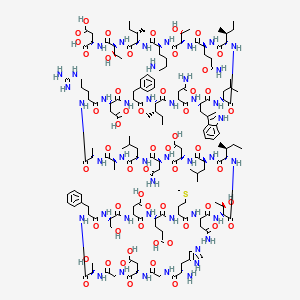
2D structure diagram from NCBI PubChem. This is the actual molecular structure of Tezelparatide.
Description
Tezelparatide is a long-acting analog of glucagon-like peptide-2 (GLP-2), a 33-amino-acid peptide hormone produced by enteroendocrine L-cells in the distal small intestine and colon. GLP-2 is co-secreted with GLP-1 in response to nutrient ingestion, but while GLP-1 primarily affects appetite and insulin secretion, GLP-2 is the body's primary intestinotrophic hormone — meaning its central role is to stimulate growth, maintenance, and repair of the intestinal mucosa. GLP-2 acts through GLP-2 receptors expressed on enteric neurons, subepithelial myofibroblasts, and enteroendocrine cells throughout the GI tract.
The mechanism of action involves multiple downstream effects: GLP-2 receptor activation stimulates crypt cell proliferation (increasing the production of new intestinal epithelial cells), inhibits apoptosis of villus cells (prolonging the lifespan of existing absorptive cells), enhances intestinal blood flow, upregulates expression of nutrient transporters, and strengthens the intestinal barrier function. The net result is increased villus height, deeper crypts, greater mucosal surface area, and enhanced nutrient absorption capacity. GLP-2 also reduces gastric acid secretion and gastric motility, and has anti-inflammatory effects in the gut by reducing pro-inflammatory cytokine expression.
Native GLP-2 has a half-life of approximately 7 minutes due to rapid degradation by dipeptidyl peptidase-4 (DPP-4). Tezelparatide, like its predecessor teduglutide (Gattex/Revestive), incorporates modifications that resist DPP-4 cleavage, extending its half-life significantly and enabling practical dosing schedules. The wide range of available sizes (10mg through 60mg) accommodates different research protocols and dosing durations.
Clinical Context
The approved GLP-2 analog teduglutide (Gattex) has been transformative for patients with Short Bowel Syndrome (SBS), a debilitating condition where surgical removal of large portions of the small intestine leads to malabsorption, malnutrition, and dependence on parenteral nutrition (TPN). Teduglutide treatment has enabled many SBS patients to reduce or eliminate TPN dependence by regenerating functional intestinal mucosa. Gattex carries a wholesale price exceeding $30,000/month, making it one of the most expensive specialty drugs on the market.
Beyond SBS, GLP-2 agonists are being investigated for a wide range of GI conditions including Crohn's disease, ulcerative colitis, chemotherapy-induced mucositis, radiation enteritis, intestinal graft-versus-host disease, and neonatal necrotizing enterocolitis. The intestinal barrier-strengthening properties have also generated interest in "leaky gut" research and conditions associated with increased intestinal permeability.
- Teduglutide (Gattex) carries a boxed warning for intestinal neoplasia risk — GLP-2-driven crypt cell proliferation could theoretically accelerate growth of existing neoplasms; colonoscopy is recommended before initiation and periodically during treatment
- Fluid overload: improved intestinal absorption can lead to fluid retention; IV fluid and parenteral nutrition volumes may need reduction
- Gallbladder and biliary: cholecystitis and cholelithiasis have been reported
- Intestinal obstruction: mucosal growth could theoretically worsen stricturing disease
- Polyp surveillance: increased mucosal proliferation warrants periodic colonoscopic surveillance
- The 6 available PLDS sizes suggest flexibility for titration and long-term study design
Published Research
Published Research & Clinical Data
Peer-reviewed studies and clinical trial data related to Tezelparatide
All research below is conducted by independent institutions. MedTech Research Group provides these references for informational purposes only.
Research citations are being compiled for this compound.
Check back soon — our team is curating peer-reviewed sources.