Thymosin Alpha 1
Thymosin Alpha 1 (TA1, Thymalfasin)
Research Hub — Aggregated Studies
MedTech Research Group aggregates published research from peer-reviewed journals, clinical trials, and academic institutions. We do not conduct original research. All studies cited below are the work of their respective authors and institutions. Sources are linked for verification.
This product is designated FOR RESEARCH USE ONLY (RUO). These compounds have not been approved or cleared under 21 U.S.C. § 505 and have not been evaluated by the FDA for safety, efficacy, or labeling for clinical, diagnostic, or therapeutic use in humans or animals.
MedTech Research Group will only fulfill orders to qualified researchers affiliated with accredited academic institutions, licensed research facilities, or organizations with active IRB/IACUC oversight.
Purchaser Restrictions
- Purchaser must be a qualified researcher at an accredited institution or licensed research facility
- This product may not be sold or redistributed to individual consumers, wellness clinics, health food stores, or retail establishments
- Not intended for human or animal consumption, diagnostic use, or therapeutic application
- Institutional affiliation and research purpose will be verified prior to order fulfillment
Distribution is limited to qualified research use in compliance with applicable federal and state law. These products bear the "For Research Use Only" designation per FDA labeling requirements (minimum 10 pt. font). Ref: 21 U.S.C. § 505; FD&C Act § 201(p) (unapproved new drug definition).
| Risk Tier | GREEN |
| Category | Immune / Thymic |
| Subcategory | Immune System Modulation / T-Cell Maturation |
| Pharmacological Class | Peptide |
| Subclass | Thymic Peptide / Immunomodulator |
| Molecular Type | Synthetic Peptide (28 amino acids, N-terminally acetylated) |
| Origin | Synthetic form of an endogenous peptide originally isolated from thymosin fraction 5 (calf thymus extract) by Allan Goldstein at George Washington University (1977) |
| Regulatory Status | Approved as Zadaxin (thymalfasin) in 35+ countries (China, Philippines, India, parts of South America, Europe) for hepatitis B, hepatitis C, and as an immune adjuvant. Not FDA-approved in the United States (Phase 3 trials conducted). |
| Route of Administration | Subcutaneous injection |
| Reconstitution | Lyophilized powder; reconstitute with bacteriostatic water |
| Storage | Refrigerate (2-8°C) |
Chemical Properties
| Molecular Formula | C129H215N33O55 |
| Molecular Weight | 3108.3 g/mol |
| Exact Mass | 3107.5074829 Da |
| InChI Key | NZVYCXVTEHPMHE-ZSUJOUNUSA-N |
| Synonyms |
|
| PubChem | View full record |
Source: NCBI PubChem — public domain data
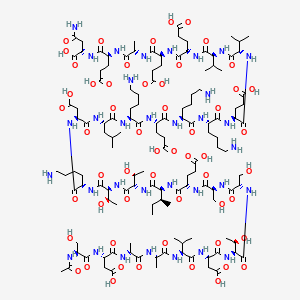
2D structure diagram from NCBI PubChem. This is the actual molecular structure of Thymosin Alpha 1.
Description
Thymosin Alpha 1 (TA1, also known as thymalfasin) is a 28-amino-acid peptide that is the primary active component of thymosin fraction 5, a partially purified extract of the thymus gland. The thymus is the central organ of T-cell development and maturation, and its involution with age (thymic involution begins at puberty and progresses throughout life) is considered one of the primary drivers of age-related immune decline (immunosenescence). TA1 is acetylated at its N-terminus, which is important for its biological activity and stability.
The mechanism of action of TA1 is multifaceted and centers on enhancing both innate and adaptive immune responses. In adaptive immunity, TA1 promotes T-cell maturation and differentiation from thymic progenitors, increases T-cell receptor diversity, enhances cytotoxic T-lymphocyte (CTL) activity, promotes Th1 cytokine production (IL-2, IFN-γ) while modulating Th2 responses, and stimulates natural killer (NK) cell activity. In innate immunity, TA1 activates dendritic cells through Toll-like receptor 9 (TLR9) signaling, enhancing antigen presentation and bridging innate and adaptive responses. TA1 also modulates immune function rather than simply stimulating it — it can reduce excessive inflammatory responses (it has been studied in sepsis for its immunomodulatory properties), making it a true immunomodulator rather than a simple immune stimulant.
Clinical Context
TA1/Zadaxin has one of the most extensive clinical databases of any peptide in this catalog, with approval in over 35 countries and use in millions of patients worldwide. Its primary approved indications are chronic hepatitis B (where it enhances viral clearance rates) and chronic hepatitis C (used as an adjunct to interferon and ribavirin therapy). It has also been studied as a vaccine adjuvant (improving seroconversion rates in elderly and immunocompromised patients receiving influenza and hepatitis B vaccines) and in the treatment of sepsis/severe infections (where immune function is critically compromised). The COVID-19 pandemic renewed interest in TA1 as an immune modulator, and several clinical studies were published during 2020–2022. Despite extensive clinical use globally, the FDA has not approved TA1 in the United States — the Phase 3 hepatitis B trial did not meet its primary endpoint by a narrow margin.
- Approved in 35+ countries as Zadaxin — extensive human safety data
- Immunomodulatory, not purely immunostimulatory — can reduce excessive inflammation as well as enhance deficient immunity
- Well-tolerated with minimal adverse effects; injection site reactions are the most common
- Higher cost ($78.51/10mg) reflects the larger peptide size (28 AA) and purification requirements
- Contraindicated in patients on immunosuppressive therapy for organ transplants (could promote rejection)
- Use with caution in autoimmune diseases — immune modulation could theoretically exacerbate autoimmune responses
- Can be used as a vaccine adjuvant to improve response rates in immunocompromised populations
- The thymus involutes with age — TA1 supplementation is conceptually replacing what declining thymic output no longer provides
Research data sourced from UniProt. CC BY 4.0 — attribution required.
MedTech Research Group provides these references for informational purposes. We do not conduct original research. All studies are the work of their respective authors and institutions.
Biological Function
Prothymosin alpha may mediate immune function by conferring resistance to certain opportunistic infections
Subcellular Location
Nucleus
Amino acid sequence length: 111 residues
Published Research
Published Research & Clinical Data
Peer-reviewed studies and clinical trial data related to Thymosin Alpha 1
20 from PubChem
All research below is conducted by independent institutions. MedTech Research Group provides these references for informational purposes only.
What should we advise about adjunctive therapies, including herbal medicines, for hepatitis C?
Sarin SK. Journal of gastroenterology and hepatology, 2000.PMID: 10921401
Bianco-Batlles D, Naylor CW, Moshier JA, Dosescu J, Naylor PH. Cellular and molecular biology (Noisy-le-Grand, France), 2001.PMID: 11292250
Ohmori H, Kamo M, Yamakoshi K, Nitta MH, Hikida M, et al.. Immunopharmacology and immunotoxicology, 2001.PMID: 11322651
Andreone P, Cursaro C, Gramenzi A, Margotti M, Ferri E, et al.. Journal of viral hepatitis, 2001.PMID: 11380797
Ancell CD, Phipps J, Young L. American journal of health-system pharmacy : AJHP : official journal of the American Society of Health-System Pharmacists, 2001.PMID: 11381492
Kullavanuaya P, Treeprasertsuk S, Thong-Ngam D, Chaermthai K, Gonlachanvit S, et al.. Journal of the Medical Association of Thailand = Chotmaihet thangphaet, 2001.PMID: 11529376
Effect of thymosin peptides on the chick chorioallantoic membrane angiogenesis model.
Koutrafouri V, Leondiadis L, Avgoustakis K, Livaniou E, Czarnecki J, et al.. Biochimica et biophysica acta, 2001.PMID: 11731086
Piper DR, Mujtaba T, Keyoung H, Roy NS, Goldman SA, et al.. Journal of neuroscience research, 2001.PMID: 11746353
Li CL, Zhang T, Saibara T, Nemoto Y, Ono M, et al.. International immunopharmacology, 2002.PMID: 11789668
Sodhi A, Paul S. International immunopharmacology, 2002.PMID: 11789669
Zhuang L, You J, Tang BZ, Ding SY, Yan KH, et al.. World journal of gastroenterology, 2001.PMID: 11819800
You J, Zhuang L, Tang BZ, Yang WB, Ding SY, et al.. World journal of gastroenterology, 2001.PMID: 11819801
Thyroid hormone-dependent regulation of Talpha1 alpha-tubulin during brain development.
Lorenzo PI, Ménard C, Miller FD, Bernal J. Molecular and cellular neurosciences, 2002.PMID: 11906207
Treatment of chronic hepatitis B: case selection and duration of therapy.
Leung N. Journal of gastroenterology and hepatology, 2002.PMID: 11982721
Thymosin alpha in the treatment of chronic hepatitis B: an uncontrolled open-label trial.
Amarapurkar D, Das HS. Indian journal of gastroenterology : official journal of the Indian Society of Gastroenterology, 2002.PMID: 11990327
Paul S, Sodhi A. Immunology letters, 2002.PMID: 12036599
Saruc M, Yuceyar H, Kucukmetin N, Demir MA, Kandiloglu AR. Hepato-gastroenterology, 2002.PMID: 12063993
Lau GK, Nanji A, Hou J, Fong DY, Au WS, et al.. Journal of viral hepatitis, 2002.PMID: 12081605
Thymosin alpha1 inhibits mammary carcinogenesis in Fisher rats.
Moody TW, Tuthill C, Badamchian M, Goldstein AL. Peptides, 2002.PMID: 12084534
Thymosin alpha1. SciClone Pharmaceuticals.
Billich A. Current opinion in investigational drugs (London, England : 2000), 2002.PMID: 12090542
42 Registered Clinical Trials
Research data sourced from ClinicalTrials.gov. Public domain (U.S. National Library of Medicine).
MedTech Research Group provides these references for informational purposes. We do not conduct original research. All studies are the work of their respective authors and institutions.
42
Total Trials
7
Recruiting
2
Active
13
Completed
Sponsor: First People's Hospital of Hangzhou · Completed: 2020-05
Sponsor: Jiangsu Hansoh Pharmaceutical Co., Ltd. · Completed: 2013-08
Sponsor: The First Affiliated Hospital of Xiamen University · Completed: 2019-12
Sponsor: Jia Fan · Completed: 2018-10
Sponsor: Yousheng Mao · Completed: 2025-12-30
Research Library — 87 Papers
Research data sourced from OpenAlex. CC0 public domain. Articles are the work of their respective authors.
MedTech Research Group provides these references for informational purposes. We do not conduct original research. All studies are the work of their respective authors and institutions.
HBV life cycle and novel drug targets
Daniela Grimm, Robert Thimme, Hubert E. Blum · Hepatology International
Research by Daniela Grimm et al., published in Hepatology International. Not conducted by MedTech Research Group.
Late immune consequences of combat trauma: a review of trauma-related immune dysfunction and potential therapies
Kelly B. Thompson, Luke T. Krispinsky, Ryan J. Stark · Military Medical Research
Research by Kelly B. Thompson et al., published in Military Medical Research. Not conducted by MedTech Research Group.
A Reappraisal of Thymosin Alpha1 in Cancer Therapy
Claudio Costantini, Marina Maria Bellet, Marilena Pariano, et al. · Frontiers in Oncology
Research by Claudio Costantini et al., published in Frontiers in Oncology. Not conducted by MedTech Research Group.
The efficacy and safety of thymosin alpha‐1 in Japanese patients with chronic hepatitis B; results from a randomized clinical trial
S Iino, J. Toyota, H. Kumada, et al. · Journal of Viral Hepatitis
Research by S Iino et al., published in Journal of Viral Hepatitis. Not conducted by MedTech Research Group.
The efficacy of thymosin α1 as immunomodulatory treatment for sepsis: a systematic review of randomized controlled trials
Fang Liu, Hongmei Wang, Tiansheng Wang, et al. · BMC Infectious Diseases
Research by Fang Liu et al., published in BMC Infectious Diseases. Not conducted by MedTech Research Group.
Prothymosin alpha: a ubiquitous polypeptide with potential use in cancer diagnosis and therapy
Kyriaki Ioannou, Pinelopi Samara, Evangelia Livaniou, et al. · Cancer Immunology Immunotherapy
Research by Kyriaki Ioannou et al., published in Cancer Immunology Immunotherapy. Not conducted by MedTech Research Group.
Thymosin alpha1 based immunomodulatory therapy for sepsis: a systematic review and meta-analysis
Congcong Li, Liyan Bo, Qingqing Liu, et al. · International Journal of Infectious Diseases
Research by Congcong Li et al., published in International Journal of Infectious Diseases. Not conducted by MedTech Research Group.
Treatment with lamivudine versus lamivudine and thymosin alpha-1 for e antigen-positive chronic hepatitis B patients: a meta-analysis
Yuanyuan Zhang, En‐Qiang Chen, Jin Yang, et al. · Virology Journal
Research by Yuanyuan Zhang et al., published in Virology Journal. Not conducted by MedTech Research Group.
Clinical Potential of Emerging New Agents in Hepatitis B
Geoffrey C. Farrell · Drugs
Research by Geoffrey C. Farrell, published in Drugs. Not conducted by MedTech Research Group.
A pilot study of the safety and efficacy of thymosin<i>α</i>1 in augmenting immune reconstitution in HIV-infected patients with low CD4 counts taking highly active antiretroviral therapy
David Chadwick, Jeffrey Pido-Lopez, António Pires, et al. · Clinical & Experimental Immunology
Research by David Chadwick et al., published in Clinical & Experimental Immunology. Not conducted by MedTech Research Group.